Remember

Remember

When challenges mount and fears loom large in the whirlwind of life, it’s easy to feel adrift, as if we’re facing insurmountable odds alone. The weight of present troubles can obscure our vision, making us forget the very source of our strength and hope. Yet, the ancient words of King David in Psalm 27:1-6 offer a profound antidote to this despair: “Remember.”

David, a man intimately acquainted with adversity – from facing giants and fleeing a jealous king to enduring betrayal and war – begins this psalm not with a lament, but with a resounding declaration of confidence: “The Lord is my light and my salvation; whom shall I fear? The Lord is the stronghold of my life; of whom shall I be afraid?” (Psalm 27:1). This isn’t a naive optimism, but a battle-tested faith rooted in memory.

David’s confidence isn’t abstract; it’s grounded in his past experiences. He recalls, “When evildoers came against me to devour my flesh, my foes and my enemies stumbled and fell” (Psalm 27:2). He had seen God’s hand move, time and again, turning the tide against seemingly overwhelming forces. It’s in these moments of divine intervention, these countless deliverances from troubles that seemed impossible to overcome, that we find a powerful testament to God’s existence and His active interaction in our lives.

Think about it: can any person truly navigate the “numerous obstacles” of life – the unexpected illnesses, the crushing losses, the sudden betrayals, the financial ruin – without some form of support? While human support is vital, there are moments when only a divine hand can provide the light in the deepest darkness, the salvation from utter despair, and the stronghold against forces that would otherwise consume us. When we look back at our own lives, at the times we somehow made it through, when a door opened unexpectedly, when peace settled in the midst of chaos, or when strength appeared from nowhere, we are witnessing God’s faithfulness. These are not mere coincidences; they are echoes of His promise, “I will never leave you nor forsake you.”

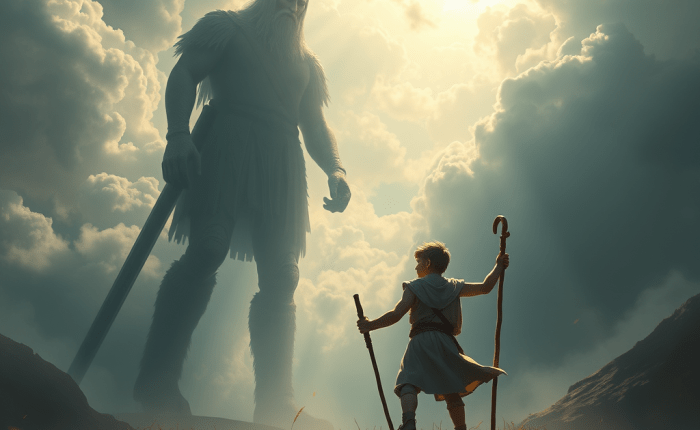
David’s life was a tapestry woven with such divine interventions. Before he ever wore a crown, as a young shepherd boy, he faced beasts that threatened his flock. He didn’t just survive; he conquered. He remembered how God enabled him to rescue his lambs from the jaws of a lion and a bear (1 Samuel 17:34-37). These weren’t minor skirmishes; they were life-or-death struggles where a shepherd boy, armed with only a staff and sling, triumphed over formidable predators.

And then came the ultimate test: Goliath, the Philistine giant, defying the armies of Israel. While seasoned warriors trembled, young David, fueled by the memory of God’s past faithfulness, stepped forward. He declared, “The Lord who delivered me from the paw of the lion and from the paw of the bear will deliver me from the hand of this Philistine” (1 Samuel 17:37). His victory over Goliath was not merely a physical feat; it was a profound act of faith, born from a deep well of remembered deliverances.

David’s reflection in Psalm 27 was likely not about one isolated occurrence, but about journeying through the halls of his memory, recalling each instance of God’s powerful intervention. This process wasn’t just nostalgic; it was an act of worship. Each recalled victory became a fresh reason to honor God with praise, solidifying his confidence that the God who had been faithful in the past would surely be faithful in the present and future. This constant act of remembering and praising transformed his past struggles into pillars of present strength, allowing him to declare with conviction, “Though an army encamp against me, my heart shall not fear; though war rise up against me, yet I will be confident” (Psalm 27:3).

This divine support is not just about external rescue; it’s also about internal transformation. The Apostle Paul reminds us in 2 Timothy 1:7, “For God has not given us a spirit of fear, but of power and of love and of a sound mind.” This verse beautifully complements David’s fearless stance. When we remember God’s faithfulness, we are empowered to overcome the spirit of fear that seeks to paralyze us. We receive a spirit of power, enabling us to face challenges with courage; a spirit of love, allowing us to respond with compassion even in difficult circumstances; and a sound mind, granting us clarity and wisdom when confusion reigns. This inner fortitude is itself a profound deliverance, a testament to God’s ongoing work within us.

It’s tempting to wish away our troubles, to pray for their immediate removal. But some of life’s most profound growth happens not by avoiding the storm, but by learning to lean into it, trusting that God is present and purposeful in the midst of it. David’s psalm isn’t just about escaping trouble; it is about finding God in trouble. His “one thing” was not freedom from enemies, but to “dwell in the house of the Lord all the days of my life, to gaze upon the beauty of the Lord and to inquire in his temple” (Psalm 27:4). He sought intimacy with God despite the surrounding chaos.

When we choose to lean into our trials, when we consciously seek God’s presence and wisdom within the difficulty, we allow Him to refine us. It’s in the crucible of adversity that our faith is tested and strengthened, like gold purified by fire.We learn resilience, patience, and a deeper reliance on God than we ever thought possible. The very things that threaten to break us can, with God’s divine support, become the tools He uses to build us into stronger, more compassionate, and more faithful individuals. We grow not just through the trials, but because of them, as God uses them to shape our character and deepen our understanding of His unwavering faithfulness.

So, when the “army” encamps against you, and “war rises up,” take a moment to pause. Remember. Remember the countless times God has been your light, your salvation, your stronghold. Remember the unseen hand that guided you, the peace that sustained you, the strength that appeared when you had none left. These memories are not just personal anecdotes; they are evidence of a living, interacting God.

Let the spirit of power, love, and a sound mind replace the spirit of fear. And as you lean into the present challenge, trust that the same God who delivered you before is actively working to grow you now. For in remembering His faithfulness, we find not just hope for today, but an unshakeable confidence for all our tomorrows.

Out of Gloom and Darkness, See

Out of Gloom and Darkness, See

Miracle: an extraordinary event manifesting divine intervention in human affairs.

Many people today dismiss the possibility of miracles because they struggle to accept that God actively intervenes in human affairs. They may witness or hear about inexplicable phenomena, yet they cannot allow themselves to believe in the evidence of God’s hand at work in people’s lives. For these unbelievers, miracles are simply assurances that science will eventually explain.

For such people, there seems to be no hope, for no matter what the Lord says or does, they have made up their minds that they will not believe. Yet, even in our modern world, stories emerge that echo the divine intervention of ancient times:

Consider the incredible healing of Ema McKinley on Christmas Eve 2011, as reported by CBN News. Wheelchair-boundfor years with a debilitating condition that left her foot and hand crooked, Ema claims that after eight hours of intense pain, “Jesus literally entered the room” and healed her. The next day, she was reportedly walking for the first time since 1993, with her limbs straightened.

In March 2015, in Utah, officers responding to a car accident found a vehicle submerged in frigid water. They reported hearing a mysterious voice calling for help, even though the adult driver had been deceased for hours. Following the voice, they found an 18-month-old baby still alive in the backseat.

And in January 2015, we heard of John Smith’s Revival. A 14-year-old boy in St. Charles County, Missouri, fell through the ice and was submerged for 15 minutes. After medical workers had given up hope, his mother prayed over him in the emergency room, and he reportedly came back to life with no lasting brain damage.

These accounts, like many others, defy easy explanation. They invite us to reconsider our understanding of what is possible when the divine intersects with the human.

The Hardness of Bethsaida’s Heart

In Mark 8:22-26, we read about Jesus’ encounter with a blind man in Bethsaida. Bethsaida was a significant fishing village on the northern shore of the Sea of Galilee, a place where Jesus performed many of his “mighty works” and miracles, including healing, feeding the five thousand, and walking on water. It was also the hometown of several of his disciples.

Yet, despite witnessing such powerful demonstrations of divine authority, the people of Bethsaida, along with those in Chorazin and Capernaum, largely remained unbelieving and unrepentant. This is why Jesus pronounced “woes” upon these cities, as recorded in Matthew 11:21-24: “Woe to you, Chorazin! Woe to you, Bethsaida! For if the mighty works done in you had been done in Tyre and Sidon, they would have repented long ago…”

What was it about Bethsaida that led to such a rejection of God’s power?

  • Hardness of Hearts: A willful rejection of divine truth, regardless of the evidence.
  • Familiarity and Complacency: They were so familiar with Jesus’ miracles that they lost their sense of awe and wonder. They became unimpressed, failing to celebrate God’s work for others because they constantly thought, “What has God done for me?”
  • Cultural and Religious Prejudices: While Bethsaida had a Jewish population, it was also a Roman city with diverse beliefs. Instead of embracing the gospel, some may have seen Jesus as a competitor to their traditions or worldviews.
  • Lack of Spiritual Discernment: Despite the physical evidence of miracles, many lacked the spiritual insight to understand Jesus’ true identity and the profound implications of His message. They didn’t truly “see” Him because they didn’t truly “know” Him.

Herein lies a crucial lesson: Being surrounded by unbelieving people, those with hardened hearts who willfully reject God and cannot recognize the movement and power of the Holy Spirit could be standing in the way of your miraculous breakthrough. Get out of Bethsaida!

The Two-Step Revelation

The first thing Jesus did when a blind man was brought to Him in Bethsaida wasn’t to heal him instantly, but to take him by the hand and lead him outside the village (Mark 8:23). This often overlooked detail is crucial, as the subsequent two-step healing—where Jesus touched him twice—often distracts us from the significance of where the healing took place. We get so caught up in wondering why it took two touches instead of one that we miss the profound context, essentially being blind ourselves to the deeper meaning within the text.

This two-stage healing is widely seen by commentators as a powerful symbol of the gradual and often incomplete spiritual understanding of Jesus’s own disciples. Their comprehension of Jesus’s identity and mission, much like the blind man’s sight, was restored progressively and often with difficulty. Jesus frequently used such moments as private teaching opportunities, helping His disciples recognize their own spiritual shortcomings as their faith developed. This miracle’s placement in Mark’s Gospel is key: it happens just before Peter confesses Jesus as the Messiah (Mark 8:29), yet immediately after, Peter rebukes Jesus for speaking of His coming suffering (Mark 8:31-33). This sequence strikingly highlights the disciples’ partial yet developing understanding.

Beyond the physical healing, the blind man’s journey also reflects a profound transition from spiritual gloom to dawning belief. When Jesus first touched him, he could only see “people; they look like trees walking around” (Mark 8:24). This wasn’t full clarity, but it was a tremendous leap from utter darkness to perceiving light and form. For a man who had lived in complete hopelessness, surrounded by a community that fostered skepticism and unbelief, even this partial sight was monumental. He had been willing to try anything, but his environment—a “Bethsaida” of worldliness and lack of faith—had undoubtedly infiltrated his spirit.

As he moved from seeing nothing to seeing something, his faith grew, preparing him for complete restoration. Jesus performed two distinct miracles: first, the physical restoration of his sight, and second, a spiritual journey out of the pervasive influence of Bethsaida’s unbelief. Friend, that’s a message for you today: you might not be where you want to be, but God has already begun bringing you from darkness into His marvelous light!

Out of Gloom and Darkness, See Clearly

Verse 25 tells us: “Once more Jesus put his hands on the man’s eyes. Then his eyes were opened, his sight was restored, and he saw everything clearly.” (Mark 8:25). And then, remarkably, Jesus sent him home, saying, “Don’t even go into the village” (Mark 8:26). The command is clear: It’s time to come out of your Bethsaida. Open your heart to believing in the power of God.

He is still in the miracle-making business. As Isaiah 29:18 prophesied, “out of gloom and darkness the eyes of the blind will see.” In 2011, He picked Ema McKinley up and stood her up straight after a 20-year slump. In 2015, He pulled John Smith out of a frozen lake after being submerged for 15 minutes.

No matter what you are in need of, whatever it is, He can fix it for you. We spend too much time looking for the extraordinary, but we should learn how to thank Him for what He does in the ordinary. As the wise say, “He woke me up this morning. He started me on my way. I should have been dead and gone, but the Lord gave me a new day!”

It’s time to leave Bethsaida, and this time, never go back. With a made-up mind, we can truly embrace the words of the timeless hymn, “Amazing Grace” by John Newton:

Amazing Grace, how sweet the sound,That saved a wretch like me.I once was blind, but now I see.

‘Twas grace that taught my heart to fear, And grace my fears relieved. How precious did that grace appear, The hour I first believed!

Are you ready to leave your “Bethsaida” behind and truly see what God is doing in your life?

References:

News Reports :

  • Ema McKinley’s Healing: Reported by CBN News in late 2011/early 2012. Specific article details would require a search on CBN.com archives (e.g., “Ema McKinley healing CBN”).
  • Utah Baby Rescue (March 2015): Widely reported by various news outlets (e.g., “Utah baby car submerged mysterious voice”).
  • John Smith’s Revival (January 2015): Widely reported by various news outlets, often referencing SSM Health St. Joseph Hospital – Lake Saint Louis and Lake Sainte Louise in St. Charles County, Missouri (e.g., “John Smith Missouri ice miracle”).

Solid Witness

Solid Witness

As we progress in postmodernity more Americans, than ever, are asking why Christianity is still so prevalent in our time. Believers in Jesus Christ are being mocked by a growing cynicism that asserts far too many Americans are still unintelligently infatuated with Jesus in the new millennium. There are a multitude of explanations for why our critics think we are silly for still believing in what they consider fairy tales about the deity of Jesus. The biggest reason critics of Christianity cannot comprehend our commitment to our faith is because they grossly underestimate the power of solid witness.

It is because of solid witness Christianity is prevalent today. Without the witness of Jesus’ resurrection Christianity may have died on the cross a forgotten fable. But, after his execution Jesus visited his followers. Like usual, he was met with disbelief. According to the witness in the Gospel of Luke Jesus put on a demonstration of his “realness” by urging people to touch him to ensure them that they were not seeing a ghost. The same Gospel records Jesus eating a piece of broiled fish; post execution. This is not to say that there were not times in which the witness made claims about Jesus appearing in a mysteriously inexplicable way after he died. Rather, it is to say that Jesus did appear resurrected as a solid being. After his death Jesus briefly appeared as one that could be seen plainly, and touched physically. He ate food, and he had apparent wounds. Christianity is alive today because of the testimony of former-unbelieving people who witnessed a solid Jesus Christ, pre and post his crucifixion.

Our critics should be aware that Christianity was birthed out of a milieu of skepticism, unbelief and scrutiny. Different from today, the consequences of making false claims about God in the First Century were deadly. Those who held claim to the extraordinary occurrences of Jesus had far more to lose than an exhaustive argument about who God is, or if God is. More difficult than accepting the professions of Jesus, is believing that multiple witnesses would be willing to die for telling imaginative stories. The testimony of those who witnessed Jesus Christ in the flesh is (1) solid in that they had far more to lose than to gain by fabricating events. Their witness is (2) solid in that they had no earthly incentive to tell such outrageous, socially unacceptable stories. Their witness is (3) solid in that they had to overcome their own doubt when encountering Jesus resurrected. In other words, it took some convincing on Jesus’ part to show that he was not a ghost, but solid. They witnessed a resurrected, solid Jesus.

Those of us who accept the testimony of Jesus’ disciples as solid witness know something that non-Christian intellectuals don’t. That is, critical thinking is not void of emotional intelligence. Just as sound decision-making requires that you use your head, it equally demands you use your gut (instinct). There are some things we simply cannot comprehend without first taking the risk of exercising faith. Sometimes we must put forth what we feel, apart from what we think. A skydiver never really knows whether her parachute is going to open until she takes a leap of faith. Thus, before jumping she is left to trust the testimonies of all those who leaped before her. Only after we decide to believe God in Jesus Christ will we be able to add to our faith knowledge. Christians know that when our intellect runs out our faith can carry us the rest of the way. This is not enough to convince a determined skeptic that Jesus was God incarnate. Nor is that the aim. The purpose is to illustrate that no intellectual pursuit will prove Jesus’ deity above the convicting testimony of a solid witness. We either believe the witness, or we don’t.

Jesus said to Thomas, after he demanded proof that Jesus had been resurrected, “Because you have seen me, you have believed; blessed are those who have not seen and yet have believed (John 20:29).” Believers are blessed because we know that only after taking a leap of faith we can give solid witness of Jesus Christ. Christianity will remain to be prevalent as long as we continue to give solid witness. We need to be careful not to leave this generation, or the next to wrestle with the nature of God with nothing more than intellect. We must pass on to them what was given to us, the testimonies of solid witness.

Read: Luke 24:36-43 & John 20: 24-27


Tidying Up

Tidying Up

What do we know, teach and do about morality? In this expanding ideological society “morality” is becoming an increasingly ambiguous term. Though the term “moral” has never been one in which we could speak about definitively, there are some attributes of morality that we all ascribe to in common. At the basic level most people would agree that human beings ought to be kind and helpful to one another. The problem is we view this basic attribute as the pinnacle of moral standard. Contrary, kindness and helpfulness is the least we do to demonstrate our sense of morality. Kindness and helpfulness is where we begin in celebrating the evolution of our humanness, not where we end.

We fail miserably at the ground level of morality; which probably explains why most of us never reach beyond being kind and helpful to others. If we were to graduate from the ground level of morality we would find that there is more to it than the way we behave towards others. There is also the morality that exists within us for us. It is the way we temper our self-destructive behavior. Our internal morality should serve to warn us of the sins we commit against ourselves. To behave with moral integrity is to be kind to others while being kind to ourselves. How moral are we if we offer the best of ourselves to others, but inflict our mind, body and spirit with toxic pollutants (e.g. selfishness, drugs, cigarettes, profanity, laziness, porn, drunkenness, poor diet)?

Demonstrating moral integrity consist of being kind and helpful to both, others and ourselves. Perhaps, only after we master these two levels of morality can we truly advance to the third and final dimension. That is, living in peace with our Creator. The ultimate morality is to express continuous gratitude for being made. We express thankfulness by celebrating creation in its various forms, and honoring the Creator. Anything less than acknowledging and paying homage to that which is responsible for your existence is immoral.

These are the three levels of morality we must know, teach and do; be kind and helpful to others as well as to ourself, while paying homage to our Creator. It is evident in how we behave towards one another that what has been simply stated about morality here is proving to be increasingly difficult as we become more diverse in our thinking. Progress we must, but how far can we expect to advance if we fail to tidy up on morality?

Read Mark 7:21-23