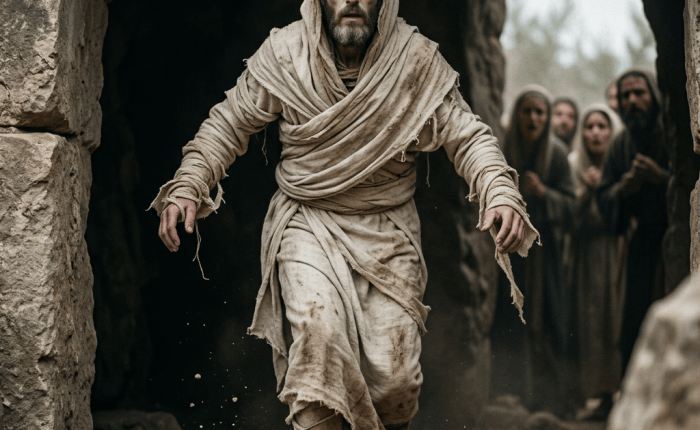
Have you ever obeyed God completely, only to sail straight into a storm?
We often operate under a quiet, unspoken assumption about the spiritual life: if we are walking in alignment with God’s will, the waters beneath us ought to be glass. We tend to link smooth sailing with divine favor, while treating headwinds, turbulence, and unforeseen tempests as evidence that we have somehow missed God’s turnoff. Yet, one of the most striking details in Matthew’s account of Jesus walking on the water directly confronts this myth.
Immediately following the miraculous feeding of the five thousand, Matthew notes that Jesus “compelled”, or literally constrained, His disciples to get into a boat and go ahead of Him to the other side. The disciples did not blunder into a nighttime tempest because of rebellion, spiritual lethargy, or straying from the path. They sailed directly into a fierce, wind-battered sea precisely because they were executing a direct command from Christ.
When your obedience leads you straight into the fourth watch of the night, where the waves are crashing, and progress feels impossible, it is vital to anchor yourself in this truth: the storm is not proof of God’s absence. More often than not, the storm is the very setting where God intends to reveal Himself in ways you could never experience from the quiet safety of a calm shore.
Why did Jesus walk on the water? In our modern, hyper-practical mindset, we might assume it was merely an issue of transportation, a shortcut across the lake to catch up with His friends after a long night of solitude and prayer. However, an exegetical look at the Hebrew Scriptures reveals something far grander. In ancient Near Eastern culture and Hebrew theology, the sea was the ultimate symbol of untamed chaos, danger, and dark, uncontrollable forces. Throughout the Old Testament, treading upon the open, roaring waters was an exclusive domain reserved for Yahweh alone. Job declares that God alone “treads on the waves of the sea” (Job 9:8), while the Psalmist writes that God’s “path led through the sea, [His] way through the mighty waters” (Psalm 77:19).
When Jesus stepped onto the surface of the Sea of Galilee in the dark of night, He was not performing a parlor trick or saving time. He was executing a divine self-revelation; a theophany. As He drew near the vessel, He called out into the dark: “Take courage! It is I. Don’t be afraid” (Matthew 14:27). The Greek phrase translated as “It is I” is Egō Eimi, the exact divine self-designation given to Moses at the burning bush—”I AM.” By standing atop the very waves that threatened to swallow the disciples, Jesus was announcing His identity: I am the Lord of creation, and the chaos that threatens to destroy you is merely pavement beneath My feet.
Before the disciples recognized the Savior, their initial reaction was sheer, unadulterated terror. They cried out, “It’s a ghost!” (v. 26). In the first-century Jewish world, popular folklore held that nocturnal waters were haunted by spirits and malicious apparitions. It is remarkably easy to critique the disciples for their panic, but how often do we do the exact same thing? When darkness settles over our lives, and unexpected trials surge around us, our default human instinct is often to misinterpret God’s active presence as a threat or an omen of impending doom.
Fear distorts spiritual vision. It transforms an approaching Savior into a terrifying specter. Notice, however, how Jesus responds to their panic. He does not instantly alter the physical weather; instead, He speaks His Word directly into their fear. The illusion of the ghost dissolves not when the wind ceases, but when the voice of the I AM pierces the night. Faith begins when we allow the reality of Christ’s character and the truth of His Word to redefine the circumstances that frighten us.
It is at this point that Peter makes his renowned request: “Lord, if it is you, tell me to come to you on the water” (v. 28). Critics often view Peter’s request as testing God or acting impetuously. However, when viewed through the lens of ancient Jewish discipleship, Peter’s motivation becomes deeply moving. A disciple (talmid) desired above all else to follow so closely behind their master that they would do what the master did and mirror the master in every way.
Peter recognized something profound in that moment: if Jesus was standing on top of the storm, then the safest place in the universe was not inside the wooden boat—it was out on the open water beside Jesus. Driven by intense devotion and radical trust, Peter stepped over the gunwale and did the humanly impossible. He walked on water toward Christ.
Of course, the story does not end with a triumphant stroll across the lake. Verse 30 tells us that when Peter saw the strength of the wind, he was afraid, and beginning to sink, he cried out, “Lord, save me!” For centuries, sermons have focused almost exclusively on Peter’s failure—how he shifted his gaze from Jesus to the wind and succumbed to doubt. Jesus Himself gently confronts Peter, asking, “You of little faith, why did you doubt?” (v. 31). Yet, there is a vital, transformative lesson here about the nature of genuine faith. When Peter began to sink, what did he do? He did not attempt to rely on his swimming skills, nor did he yell for his fellow fishermen to toss him a rope. His immediate, instinctive reaction was to direct his utter helplessness toward Jesus.
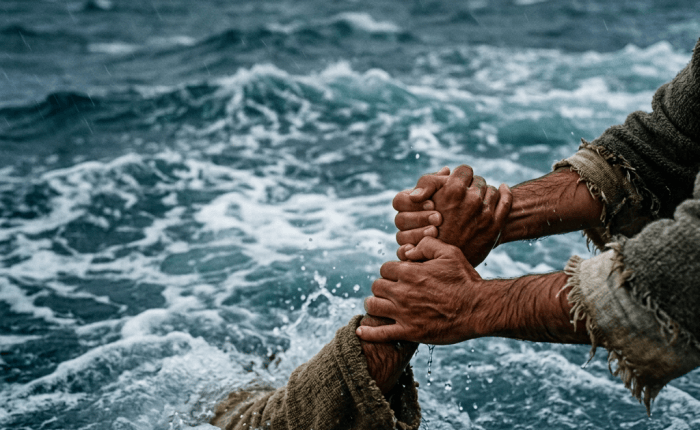
Peter’s short, three-word prayer—”Lord, save me!”—is not the collapse of faith; it is faith in action. True biblical faith is not the absolute absence of fear, nor is it a guarantee that we will never falter. True faith is knowing exactly where to direct your voice when the water reaches your neck. Jesus did not demand that Peter pull himself up by his bootstraps or prove his spiritual stamina before rescuing him. “Immediately,” Matthew writes, “Jesus reached out his hand and caught him.”
Why didn’t Jesus invite the rest of the disciples out onto the water? Why didn’t He let Peter walk all the way to the shore? Because the miracle was never intended to be a human spectacle or an exhibition of individual greatness. The journey on the water was designed to bring Christ back into relationship with the community.
When Jesus and Peter climbed back into the boat, the wind instantly died down. The vessel—which in early Christian theology came to represent the Church (navis)—became a sanctuary. The disciples who had spent the night battling the elements ended the morning kneeling on the deck in corporate adoration, confessing, “Truly you are the Son of God” (v. 33).
If you find yourself in the middle of a difficult crossing today, struggling against relentless headwinds despite doing your absolute best to obey God’s calling—take heart. The storm you are navigating is not an obstacle to His plans. It is the very stage He reveals His identity as the I AM.
When fear whispers that you are seeing ghosts, listen for His voice. When your faith wavers and the waves begin to overtake you, stop trying to swim on your own energy. Cry out the simplest, most powerful prayer ever uttered: Lord, save me. He is immediately reaching out His hand to pull you up, calm the chaos, and carry you safely to the other side.