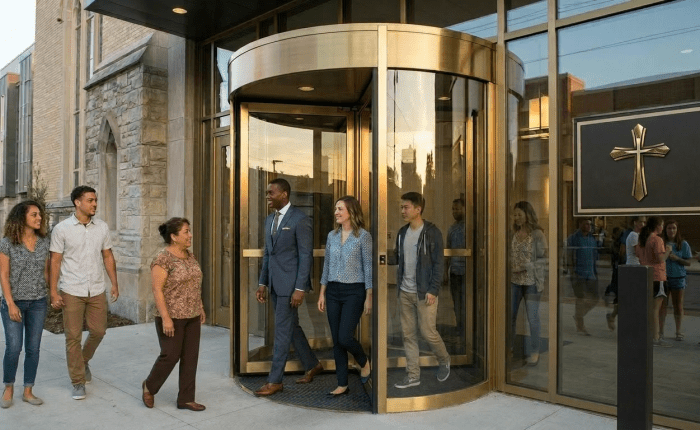
Bad Growth: Closing the Church Revolving Door

Bad Growth: Closing the Church Revolving Door

There is a distinct, intoxicating energy that accompanies a new season of leadership in the local church. When fresh leaders step into roles of influence, they arrive armed with zeal, modern strategies, and an undeniable hunger to see the sanctuary filled. For a leader who has not yet weathered the shifting seasons of ministry, the solution to a quiet sanctuary seems simple: market more aggressively, design trendier programs, craft wittier social media hooks, and adapt the church’s public facing profile to mirror the popular culture.

To these eager hearts, a full pew is the ultimate sign of success. But to those who have spent decades in the trenches of pastoral ministry, a crowded room can sometimes be a beautiful illusion masking a silent crisis.

Having served as a faith leader for sixteen years, I have watched the numerical tide of the church roll in and out. I have taken the helm of a congregation when only seventeen faithful souls sat in the pews, and I have felt the thrill of watching that community swell to over one hundred active participants. I have also navigated the painful, disorienting contraction of the post-COVID-19 era, watching our numbers settle back down to forty or sixty. Now, as the tide begins to rise once more, I find myself standing at a familiar and critical crossroads.

Our new leaders, motivated by a genuine desire to reach the lost, want to launch campaigns to attract the masses. They want to fill the pews. What they do not yet understand, and what only years of tear-soaked prayers and empty seats can teach you, is that there is a fundamental difference between growth and good growth.

If we build a church on the foundation of witty offers, entertainment, and worldly hooks, we will inevitably build a church of consumers rather than disciples. And in doing so, we leave the revolving door of church membership wide open.

The Illusion of the “Rocky Soil” (Understanding Bad Growth)

In His wisdom, Jesus diagnosed this pastoral dilemma long before modern church marketing existed. In the Parable of the Sower, He spoke of seed that fell on rocky ground: “Some fell on rocky places, where it did not have much soil. It sprang up quickly, because the soil was shallow. But when the sun rose, the plants were scorched, and they withered because they had no root” (Matthew 13:5-6).

Notice the diagnostic marker of bad growth: it sprang up quickly.

To the untrained eye, the rapid green sprouts on the rocky soil look like a revival. It looks like success. But because there is no depth, the growth is unsustainable. In the context of the local church, “bad growth” is numerical expansion that is decoupled from spiritual depth and sincere conversion. It is the gathering of a crowd under false pretenses.

When we entice people into the house of God using the same bait the world uses to lure them into theaters, concert halls, and shopping malls, we set a dangerous precedent. We establish a contract with the attendee: “If you come here, we promise to keep you entertained, comfortable, and socially engaged.” The problem with this contract is that the church can never truly compete with the world on the world’s terms. More importantly, when you win people to something, you must keep them by that very thing. If they are attracted by a witty marketing campaign or a high-energy program, they will remain only as long as you can hold their attention. The moment the program loses its novelty, or a more entertaining option opens down the street, they will slip out the back door as quickly as they entered the front. This is the origin of the revolving door. It is exhausting, spiritually depleting, and ultimately builds an audience, not a kingdom institution.

The Wisdom of the Forty-Year Mentor

Years ago, my pastor and mentor, a man who had spent over forty years guiding souls through the complex wilderness of local ministry, handed me a piece of wisdom that forever altered my approach to the pulpit. Observing my youthful frustration with fluctuating numbers, he sat me down and said:

“Son, all growth is not good growth. Some growth is rapid and unsustainable, while other growth is too slow and low. What you want is steady, consistent growth that creates a strong church. You shouldn’t aim for a big church. What you want is to pastor a strong church.”

These words sounded almost counterintuitive to a young pastor eager to make an impact. We live in a culture that equates bigger with better and quantity with quality. But my mentor understood a truth that protects a pastor’s soul: a big church can be incredibly weak, but a strong church will always be exactly as large as God needs it to be to accomplish His purposes.

A weak, large church is a crowd of spectators. A strong, healthy church is a community of contributors.

When we focus solely on filling the pews, we prioritize attendance over adherence. We value heads over hearts. This dynamic produces a passive congregation that expects to be served rather than to serve. They do not immerse themselves in the community; they do not carry one another’s burdens; they do not make sacrifices to advance the Kingdom of God. When a crisis hits—whether it is a global pandemic, a cultural shift, or a personal trial—the weak church crumbles because its members are consumers, not covenant partners.

Conversely, a strong church possesses spiritual infrastructure. It is comprised of individuals who have deep roots in Christ and deep cords of covenantal relationship with one another. When the storms of life or culture beat against a strong church, it stands firm because it is anchored on the Rock, not on the shifting sands of entertainment and consumer preference.

Comparing the Two Paradigms

To help our eager new leaders understand this shift, we must clearly contrast the two approaches to church life. The attractional paradigm, which drives “bad growth,” centers its primary goals on numerical expansion by simply filling the pews. Its methods rely heavily on witty hooks, popular culture, and entertainment, sending an underlying message of “look what we can do for you.” This positions the attendee as a mere consumer or spectator, resulting in low sustainability because it requires constant novelty to retain people. When a crisis inevitably hits, this model suffers high attrition, offense, and departure because there are no deep roots.

In stark contrast, the discipleship paradigm, which yields “good growth,” focuses on spiritual maturity, forming Christ in people. It utilizes the time-tested methods of Gospel proclamation, authentic community, and sacrificial service, offering the challenging invitation to “come, die to yourself, and follow Christ.” Here, the attendee is a disciple and an active contributor. The sustainability of this model is exceptionally high because it is rooted in eternal truth and deep relationship. When crises arrive, this community responds with resilience, mutual support, and a deeper commitment to one another and to God.

Redirecting the Zeal: How to Channel Eager Leadership

How do we speak to this new generation of leaders without quenching their spirit? We do not tell them to stop inviting people. We do not tell them to hate growth. Instead, we call them up to a higher, more demanding standard of growth. We must teach them to channel their promotional energy away from “attraction” and toward “immersion.”

Shift the Invitation from “Come and See” to “Come and Die”

Dietrich Bonhoeffer famously wrote in The Cost of Discipleship, “When Christ calls a man, he bids him come and die.” The gospel is not a product to be marketed with clever slogans; it is a counter-cultural call to surrender. When we invite people to church, we must be honest about what we are inviting them to. We are inviting them to a family where they will be expected to love, forgive, serve, give, and grow. Paradoxically, people are deeply hungry for a call to sacrifice. While worldly hooks might get people through the doors for a week, a high and holy call to discipleship is what makes them stay for a lifetime.

Measure What Matters

If we only celebrate Sunday morning attendance, our leaders will naturally focus all their energy on Sunday morning attendance. We must change our metrics of success.

If we want to gauge true, kingdom-building growth, we must look to the waters of baptism. Real church growth should be measured by how often we wet the baptismal pool. A dry baptistery in a crowded church is a profound warning sign; it tells us we may be collecting spectators, but we are not cultivating converts. When we celebrate the wetting of the baptismal pool, we are celebrating death to self, resurrection in Christ, and the public covenant of a soul surrendered to God. That is a metric of spiritual life, not just physical attendance.

In addition to this primary mark of discipleship, we must expand our focus to celebrate other vital indicators of a healthy community. We must look at how many people are stepping out of the passive pews and into small, intimate discipleship groups where true, life-on-life ministry happens. We must measure our impact by how many members are actively serving our local community outside the church walls. Ultimately, true success is found in the stories of reconciled marriages, broken addictions, and quiet acts of generosity, as well as the quiet, steady spiritual fruit that outlasts any loud, temporary numerical spikes. When our leaders see that the pastor values depth over height, they will begin to align their strategies to cultivate deep roots.

Closing the Door

The revolving door of church membership is a tragedy that quietly breaks the hearts of pastors and exhausts the souls of faithful volunteers. It is a symptom of a church that has mastered the art of introduction but failed at the art of integration.

To my beloved, zealous, and visionary new leaders: I share your hunger to see our church grow. I want our seats filled, our hallways buzzing with life, and our impact felt across our city. But I love you, and I love the flock of God, too much to give you a church built on sand.

Let us not settle for the cheap thrill of a rapid, shallow crowd. Let us commit to the steady, holy, and beautiful work of building a strong church. Let us sow seed deep into the soil of sincere repentance, authentic fellowship, and passionate devotion to Jesus Christ. When we do this, the growth we experience will not be a fleeting wave that leaves us empty in the next season, but a constant, unstoppable tide that closes the revolving door and builds a house that will stand for eternity.

Your Pastor is a Gift from God

Your Pastor is a Gift from God

Many churchgoers and individuals alike often hold a superficial understanding of what the church truly is and how it functions within their lives. This ignorance frequently extends to a profound misunderstanding of the roles of faith leaders. When we fail to grasp the essence and purpose of the church, cultivating a healthy, reciprocal relationship with its leadership becomes nearly impossible. While most acknowledge that the church and its pastors exist to “serve” or “minister,” the practical “how” remains largely undefined in their minds.

Faith leaders are often perceived as figures attached to a particular building—like gears in an institutional machine—rather than as integral members of a spiritual family. To many, their pastor is akin to a distant relative at a family gathering: present, but not intimately known, consulted only in moments of crisis or when an urgent need, like a wedding venue, arises.

This prevailing perception leads to a significant forfeiture of invaluable support. We unknowingly relinquish a wealth of guidance and care when we neglect to establish a genuine relationship with the faith leaders “given to us.” The Apostle Paul, in Ephesians 4:11-13, illuminates this profound truth:

“So Christ himself gave the apostles, the prophets, the evangelists, the pastors, and teachers, to equip his people for works of service, so that the body of Christ may be built up until we all reach unity in the faith and in the knowledge of the Son of God and become mature, attaining to the whole measure of the fullness of Christ.”

The New Living Translation’s opening—”Now these are the gifts Christ gave to the church…”—underscores this revelation: pastors, alongside other spiritual guides, are not merely professionals or administrators but divine gifts from God Himself. The Lord Jesus Christ did not gift a structure or an organization; He gifted people as pastors. More profoundly, He gifted every believer a personal faith leader, both collectively within the body and individually.

Imagine the profound implications of this divine provision: we have the opportunity to unwrap a gift tailor-made for us. A curious exploration of the pastor’s role would reveal a treasure of knowledge, wisdom, care, understanding, and potent praying power. The realization that faith leaders possess the capacity to intercede on our behalf, approaching heaven with our concerns, is in itself a compelling reason to embrace and unravel this divine gift.

Once we embrace this incredible blessing, the true scope of its benefits, as outlined in Ephesians 4:11-13 and elaborated upon through further scriptural understanding, becomes clear:

  • Equipping God’s people for works of service: Pastors are entrusted with training and preparing believers for active ministry. Their role isn’t to shoulder all the work but to empower and enable the entire congregation to utilize their spiritual gifts, serving both within the church and the wider world.
  • Building up the body of Christ: Pastors equip, strengthen, and steer the church’s growth. Their focus encompasses both numerical increase and spiritual maturation.
  • Attaining unity in the faith and the knowledge of the Son of God: Through the faithful ministry of pastors, believers are guided toward a deeper, unified comprehension of Christian truth and a more profound, intimate knowledge of Jesus Christ. This unity defends against division and promotes doctrinal soundness.
  • Becoming mature, attaining to the whole measure of the fullness of Christ: Pastors serve as spiritual guides, leading believers toward profound spiritual maturity, shaping them to increasingly reflect Christ’s character and conduct. This involves moving beyond spiritual infancy, becoming firmly established in faith, and not being easily swayed by deceptive teachings.

While Ephesians 4:11-13 directly articulates these core functions, the qualities of knowledge, wisdom, care, concern, mentorship, and intercessory prayer are inherently woven into the fabric of a pastor’s role and are indispensable for fulfilling the passage’s mandates. The ability to “equip God’s people” and lead them to “unity in the faith” necessitates a pastor’s knowledge of Scripture, enabling them to teach truth and safeguard the flock from error, as warned in verse 14.

Beyond knowledge, wisdom is essential for applying biblical truth to life, guiding individuals through challenges, and discerning God’s will. The very term “pastor,” derived from the Greek “poimenas” (shepherd), intrinsically implies profound care and concern for the flock—a vital nurturing aspect for “building up the body of Christ.” Mentorship is a natural outgrowth of equipping and leading to maturity, as pastors guide, train, and model Christ-like living. Furthermore, a pastor’s spiritual leadership and deep care for their flock inherently involve intercessory prayer, a fundamental aspect of pastoral care and a key way they “serve” and “build up” the body.

A Deeper Dive

Pastors offer critical protection from false teaching and cultivate spiritual discernment. Ephesians 4:14 explicitly states, “Then we will no longer be infants, tossed back and forth by the waves, and blown here and there by every wind of teaching and by the cunning and craftiness of people in their deceitful scheming.” Through sound teaching and unwavering commitment to biblical truth, pastors act as shields against errant doctrines.

The divine gift of leaders also establishes order and stability within the church. Pastors, as overseers, contribute to the healthy functioning of the community by providing spiritual guidance, resolving conflicts (Matthew 18:15-17), and ensuring smooth operations. Their role also encompasses encouragement and, when necessary, loving admonishment, both crucial for “building up the body of Christ” (1 Thessalonians 5:12-13; Titus 2:15).

Pastors bless the congregation by modeling Christ-like character, serving as living examples of integrity, humility, and faithfulness (1 Timothy 3:1-7; Titus 1:5-9). By equipping saints for ministry, pastors actively cultivate a culture of service, transforming the church from a passive “consumer” entity into a vibrant, “contributing” body. Their primary means of equipping is through spiritual growth fostered by preaching and teaching—regular, clear, and challenging exposition of God’s Word that nourishes believers and prompts them to apply biblical truths. As shepherds, pastors offer vital pastoral care and support, providing comfort, guidance, and assistance during times of crisis, grief, and personal struggle. Finally, when pastors effectively lead and teach, they foster unity in purpose and mission within the congregation. They foster a shared vision for reaching the lost, serving the community, and glorifying God.

The prevalent disconnect between the average churchgoer and their understanding of church leadership isn’t merely a semantic oversight; it represents a profound missed opportunity for spiritual growth, support, and community. By failing to recognize faith leaders as divine gifts, specially appointed by Christ to equip, build up, and unify His body, we inadvertently limit our own access to the very resources necessary for a vibrant and mature faith.

Embracing the biblical truth that pastors are heaven-sent provisions unlocks a wealth of knowledge, wisdom, protection, and intercession designed to help us flourish personally and collectively. When we move beyond viewing faith leaders as mere institutional figures or emergency contacts and instead see them as cherished, God-given guides, we open ourselves to the transformative power of a healthy, Christ-centered relationship. This relationship propels us toward spiritual maturity and empowers us to fully participate in the glorious purpose of the church.

It’s time for the church to truly understand its leaders—not as employees of a building, but as integral, invaluable gifts, unwrapped and cherished for the building of God’s kingdom on earth.

Violent Shaking 

Violent Shaking 

The account in Mark 1:21-28 offers profound insights into the nature of spiritual warfare and the process of deliverance. While the narrative itself is straightforward, a closer examination of the details, particularly the violent shaking experienced by the demon-possessed man, reveals a crucial aspect of encountering the power of Jesus Christ.

Upon entering the synagogue in Capernaum on the Sabbath, Jesus immediately distinguished Himself from the scribes through the inherent authority of His teaching. This authority, stemming from His divine nature, directly confronted the spiritual darkness present within the congregation. The immediate manifestation of this confrontation was the outcry of a man possessed by an impure spirit. This entity, acutely aware of Jesus’ identity and power (“I know who you are—the Holy One of God!”), recognized the imminent threat to its dominion.

Jesus’ response was direct and authoritative: “‘Be quiet!’ said Jesus sternly. ‘Come out of him!’” It is in the immediate aftermath of this command that we observe a significant detail often overlooked: “The impure spirit shook the man violently and came out of him with a shriek” (Mark 1:25-26).

This violent shaking is not a mere incidental detail. It underscores the intense resistance of demonic forces when confronted by the power of God. The unclean spirit did not willingly relinquish its hold; rather, it was forced to depart, and its departure was marked by a physical and visceral manifestation of its struggle. This violent convulsion serves as a potent reminder of the reality of spiritual bondage and the forceful nature often required for true liberation.

Consider the implications for our own lives and the lives of those we minister to. The passage suggests that deliverance from the grip of Satan and his forces may not always be a serene or comfortable experience. There can be internal turmoil, external pressures, and a significant shaking as the strongholds are broken. This shaking can manifest in various ways: emotional upheaval, relational strain, or even physical symptoms.

For the serious Bible reader, this episode cautions against a simplistic or passive understanding of spiritual liberation. It highlights the active and often forceful intervention of divine power necessary to overcome the resistance of the adversary. Just as the impure spirit violently shook the man before its expulsion, those bound by spiritual oppression may experience a period of intense struggle as the forces of darkness are dislodged.

Furthermore, the reaction of the onlookers (“They were all so amazed…”) underscores the unprecedented nature of Jesus’authority. His word alone was sufficient to command and effect deliverance, a stark contrast to the often-ineffectual methods of the religious leaders of the time. The violent shaking served as undeniable evidence of the power unleashed by Jesus’ command.

The detail of the violent shaking in this account is not to be dismissed. It serves as a crucial theological point: the liberation from demonic influence is often a forceful and disruptive event, signifying the intense battle between the kingdom of God and the kingdom of darkness. For serious Bible readers and Christians, this passage offers both a realistic perspective on the challenges of spiritual warfare and a powerful assurance of the ultimate authority and delivering power of Jesus Christ. The shaking may be intense, but it is often the precursor to the shriek of defeat from the enemy and the profound peace of true freedom.