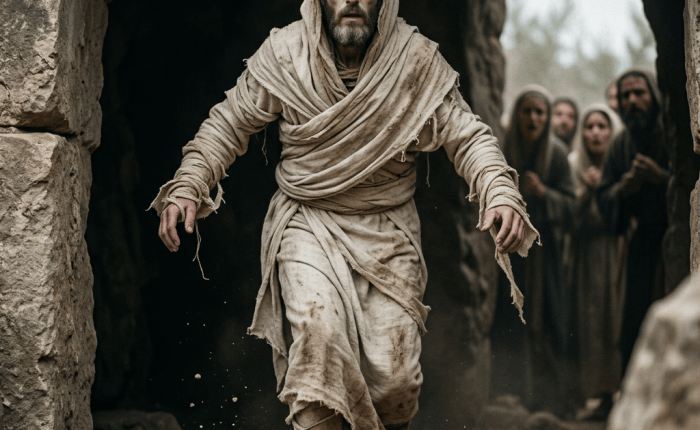
Take Off the Grave Clothes

Take Off the Grave Clothes

Have you ever stopped to consider how strange it is when God addresses dead things? Throughout Scripture, we encounter moments where the Almighty speaks directly into contexts defined by silence, decay, and finality. In Ezekiel 37:1–4, the prophet is led into a valley filled with sun-bleached human bones, the remnants of lives long gone. In that desolate landscape, God commands Ezekiel in verse four to prophesy to the dry bones and say, “O ye dry bones, hear the word of the LORD.” Centuries later, in John 11:38–44, Jesus stands before a tomb housing His friend Lazarus, who had been dead for four days. In verse forty-three, Jesus shouts into the darkness, “Lazarus, come forth!”

In both accounts, the dead are presumed to be able to hear. They are spoken to not as passive matter, but as entities capable of receiving a command. To human logic, commanding a corpse to listen seems foolish. Yet with God, His words don’t just describe reality—they create it. Theologians call this the effectual call. When God speaks into spiritual or physical death, His Word doesn’t depend on our human ability. Instead, the utterance itself imparts life, forming the ability to respond.

Understanding this truth shifts the primary question of our human experience. The pressing issue facing our souls is never whether God is actively speaking into our dead, exhausted, or stagnant circumstances. His voice is continually echoing across the valleys of human despair and shouting into the closed tombs of our spiritual paralysis. Rather, the crucial question is simple: when His living Word grants you the capacity to wake up, will you step into resurrection life or stay in the quiet familiarity of the tomb?

To respond to this divine summons, we must first recognize that God addresses our potential rather than our present posture. When Ezekiel surveyed the valley in Ezekiel 37, his eyes reported only dry, scattered bones. When Martha stood outside her brother’s tomb in John 11, her perspective was locked onto the reality of decomposition. Human perception is habitually restricted to current states. We look at broken relationships, deeply ingrained habits, spiritual apathy, or suffocating regrets, and conclude that the story has ended. However, God never addresses you based on the static posture of your current failure. His voice decrees what shall be according to His sovereign purpose. When God commanded the prophet to preach to dry bones, He was speaking to an army that had not yet stood up. When Jesus called Lazarus by name, He was addressing a living servant, not a rotting corpse.

This truth demands that we silence the lying narratives that keep us entombed in despair. You are not defined by the graveyard of your past mistakes, nor are you permanently trapped by spiritual apathy. God is not conversing with the corpse of who you used to be, nor is He intimidated by the stench of your past failures. He is actively speaking to the redeemed and resurrected self that He declared before the foundation of the world. The moment you recognize that His voice is calling you beyond your present posture, you are empowered to lift your eyes above your circumstances and respond to your Creator, who is calling you back to life.

While divine grace provides the capacity to wake up, faith requires a personal choice to step forward into freedom. Consider the mechanics of Lazarus’s awakening in John 11:44. The text tells us that he who was dead came forth, bound hand and foot with grave clothes. Picture that extraordinary moment: a man wrapped tightly from head to toe in burial strips, moving toward the light. Jesus supplied the reanimating power that restarted Lazarus’s heart, yet Lazarus still had to physically shuffle toward the cave’s opening. Resurrection power is an invitation, never a coercion. God’s grace grants you the ability to hear and stand, but He will not drag you out of the tomb against your will.

Far too often, we pray for God to transform our lives while refusing to abandon the shadowed comfort of our spiritual graves. It can feel intimidating to step into the light of accountability and holiness when you have grown accustomed to the dark. The tomb may be unpleasant, but its confines are predictable. Yet, staying in the dark after life has been offered is a choice to embrace deathly unfulfillment. The call has gone out, and the Holy Spirit has imparted spiritual capacity. You must now decide whether you will linger in the familiar shadows of compromise or make the courageous decision to move toward the light of God’s presence.

Furthermore, stepping into life requires us to unbind ourselves from the past and strip away the garments of our former state. When Lazarus emerged from the cave, he was unequivocally alive, yet he remained wrapped in burial garments. Seeing this in John 11:44, Jesus commanded the community, “Loose him, and let him go”—a directive to take off the grave clothes. This striking image illustrates a profound spiritual reality: it is entirely possible to be saved, regenerated, and loved by God, yet still walk around wrapped in the lingering habits, toxic mindsets, and crushing shame of your former existence.

Grave clothes represent old identities that no longer belong to a resurrected child of God. They manifest as the heavy rags of guilt over forgiven sins, the restrictive wrappings of old coping mechanisms, or the dark shroud of negative thought patterns whispering that you will never be whole. You cannot walk fruitfully in the newness of eternal life while continuing to wear the uniform of the grave. Jesus did not call you out of death merely to leave you shrouded in reminders of your captivity. He desires your complete liberation, inviting you to unbind every lingering artifact of death and take off the grave clothes so that you may walk in glorious, unencumbered freedom.

Ultimately, the miraculous restorations in Ezekiel 37 and John 11 were prophetic signposts pointing toward a far greater reality. Ezekiel spoke to a valley of dry bones, and they stood up as an army. Jesus called to a dead friend, and Lazarus walked out of a tomb. Yet years later, those soldiers returned to dust, and Lazarus faced physical mortality once again. But three days after Calvary, when Jesus Christ stepped out of His garden tomb, He shattered the power of death forever. No human voice had to shout into His cave to wake Him, for He is Himself the Resurrection and the Life. By His authority, He broke the bonds of the grave and opened the doorway to eternal life.

In John eleven, Jesus makes the definitive declaration that He is the resurrection and the life, assuring us that whoever believes in Him will live even if they die. Right now, that exact same voice, the voice that rattled dry bones in the ancient valley and shattered the dark quiet of the Bethany tomb, is speaking directly to the depths of your spirit. If you are weary of surviving in the dark cave of spiritual emptiness, and if you are exhausted from carrying the heavy grave clothes of past mistakes, know that your Redeemer is calling your name. Hear the Word of the Lord today, choose life over the tomb, strip away the burial garments of your past, and step boldly into the freedom of His resurrection power. Take off the grave clothes.


Ascending and Descending

Ascending and Descending

Have you ever found yourself stranded in the ‘in-between’? It is that uncomfortable, disorienting space where you have left behind what was familiar, yet you haven’t arrived at where you are going. You are suspended in transit—navigating the wilderness, surrounded by uncertainty, and wondering whether God has somehow lost track of your location.

In Genesis 28, we meet a man caught in the ultimate in-between: Jacob. Verse 10 records a geographical detail that doubles as a spiritual diagnosis: “Jacob left Beersheba and set out for Harran.” Beersheba was home, the land of promise, covenantal security, and family warmth. Harran was a distant, unknown, intimidating territory. But Jacob didn’t leave home on a planned vacation or a peaceful pilgrimage; he fled.

Just chapters earlier, Jacob lived up to the literal meaning of his name—the “heel-catcher” or “supplanter.” He deceived his blind father, Isaac, and manipulated his twin brother, Esau, out of his birthright and blessing. Now, with Esau hunting his life, Jacob runs into the desert with no security detail, no travel companions, no luggage, and no cushion of comfort. He carries only a wooden staff in his hand, a heavy burden of guilt in his chest, and the echo of a death threat ringing in his ears.

When the sun sets, Jacob stops out of sheer exhaustion. The scripture simply notes: “He came to a certain place.”Notice that the text does not even dignify the location with a name initially—it is just “a certain place,” a nameless, barren, dusty patch of dirt in the wilderness. Exhausted, isolated, and terrified, Jacob does the unthinkable: he picks up a rock, places it under his head as a pillow, and falls asleep under the cold night sky.

Can you feel the vulnerability of that moment and the hard edge of that stone? Jacob was at his absolute lowest point, physically exhausted, emotionally drained, socially isolated, and spiritually bankrupt. If anyone seemed entirely disqualified from receiving a divine revelation from the Creator of the universe, it was Jacob on that dark night. Yet, it is precisely in this undeserving place that heaven breaches earth.

As Jacob sleeps on that hard rock, he dreams. In this dream, he beholds a sullam. Traditionally translated into English as a “ladder,” the Hebrew term more accurately describes a massive, elevated stairway or grand stone ramp, much like the ziggurats of ancient Mesopotamia. This was no rickety wooden ladder; it was a majestic highway of stone whose base rested firmly in the earthly dirt while its top reached into the highest heavens.

On this divine highway, Jacob observes a startling detail: “the angels of God were ascending and descending on it.”(Genesis 28:12) Take a close look at the sequence. The scripture does not say they descended and ascended; it explicitly says they were ascending first, and then descending. If angels reside in heaven, why are they going up before coming down?

The early church father Saint Augustine, along with generations of scholars since, pointed out a profound spiritual truth hidden in this order: The angels were already on the ground with Jacob before he even realized it. While Jacob was running in fear, while he was weeping in isolation, and while he was placing his head on a cold stone, God’s celestial messengers were already standing guard in the dirt beside him. They ascended to report, and they descended to minister.

This sequence reveals a crucial truth about God’s character: Heaven is not locked away behind distant, closed doors. We often drift into the quiet misconception that God is an aloof, distant observer who only intervenes when we have our lives completely cleaned up. But the vision of the stairway reveals a bustling, dynamic, continuous connection between heaven and earth. God’s grace is never static; it is constantly active, surrounding us long before our spiritual eyes are opened to see it.

As Jacob’s eyes trace the stairway upward, he sees the Lord Himself standing at the summit. In a human story, this would be the moment for a divine reprimand. We would expect God to say, “Jacob, look at the mess you’ve made! Look at how you lied to your father and cheated your brother! Go back, fix your life, and then we can talk.” Instead, God does not descend in judgment; He descends in covenant.

Listen to the promise God speaks over this exhausted fugitive:

“I am the Lord, the God of your father Abraham and the God of Isaac. I will give you and your descendants the land on which you are lying… I am with you and will watch over you wherever you go, and I will bring you back to this land. I will not leave you until I have done what I have promised you.” (Genesis 28:13-15)

This is stunning grace. Jacob did not pray for this encounter; he did not fast, build an altar, or present an offering. Theologians refer to this as prevenient grace—the grace of God that goes before us. It is the persistent love that pursues us before we know we are lost and meets us when we have nothing left to give. In this revelation, God makes three unconditional pledges: His Presence (“I am with you”), His Protection (“I will watch over you wherever you go”), and His Permanence (“I will not leave you”).

God does not condition these promises on Jacob’s perfection; He anchors them entirely in His own unfailing character. Your present location—no matter how desolate—does not limit God’s capacity to distribute His grace. He does not demand that you escape the wilderness before He meets you; He enters the wilderness to be with you.

In verse 16, the dream vanishes, and the morning sun rises over the horizon. Jacob opens his eyes. Externally, nothing about his physical circumstances has altered: he is still in the barren desert, the wind is still cold, and the ground is still hard. But internally, everything has shifted. Jacob speaks with holy awe: “Surely the Lord is in this place, and I was not aware of it.”

What a profound confession! He does not say God was absent; he admits that he was simply unaware. How often do we walk through our days blinded to the divine presence around us? Caught up in our anxieties, financial pressures, family struggles, or career demands, we trek right past the thin places where heaven meets earth.

Jacob does not leave this encounter as a passive observer. He acts upon it. He takes the very stone he used as a pillow—the symbol of his pain, exhaustion, and loneliness—and sets it up as a pillar. He pours oil over it, consecrates it, and renames the place Bethel, meaning “House of God.” His act of worship transforms the landscape, turning the scene of his deepest vulnerability into an altar of lasting faith.

Centuries later, Jesus stood before His early followers and declared: “Very truly I tell you, you will see heaven open, and the angels of God ascending and descending on the Son of Man.” (John 1:51) Jesus intentionally referenced Jacob’s dream, but with a revolutionary revelation: Jesus did not come merely to point out where the stairway was located—He declared that He IS the stairway.

Jesus is the ultimate sullam. In His divinity, He reaches the highest heaven; in His humanity, He plants His feet firmly in our earthly dust. Through Christ, every place can become a Bethel, and access to the Father is no longer restricted by geography or human merit.

What is the hard “stone” you are resting on today? Is it fear, grief, guilt, or an uncertain future? Do not despise your stone. In the hands of God, the place of your greatest trial can become the monument of His greatest mercy. Wake up to His presence today, for He promises: “I am with you, and I will not leave you.”

From Fear to Favor

From Fear to Favor

We live in a culture caught in a strange, polarized paradox. On one hand, we are in a perpetual state of trembling. We lie awake at night, anxious about the daily news cycle, paralyzed by financial instability, or terrified of failing the people we love. We are hypersensitive to every shift in our circumstances. Yet, on the other hand, when it comes to the Sovereign Creator of the universe, our world exhibits a profound, casual apathy. We have domesticated God, reducing Him to a harmless, cosmic bystander. We tremble at everything in the world, yet we have lost the capacity to tremble before Him.

This lack of holy fear is perhaps the greatest spiritual crisis of our time. We cannot experience the weight of God’s favor if we have never felt the weight of His holiness.

It is this reality that has created a profound holy tension. How do we transition from the cold, irreverent apathy of our culture to a genuine, trembling fear of the Lord—and from there, into His intimate favor? How do we move from treating God as irrelevant to trembling at His majesty to ultimately resting in His love?

The answer to this modern crisis is beautifully captured in a single, remarkable verse from the Old Testament prophet Zephaniah:

“The Lord your God is with you, the Mighty Warrior who saves. He will take great delight in you; no longer will he rebuke you, but will rejoice over you with singing.” — Zephaniah 3:17 (NIV)

To fully appreciate the depth of this promise, we must look at the historical backdrop of the small, overlooked prophetic book that houses it.

The Danger of Complacency

To understand the beauty of God’s favor in Zephaniah 3:17, we have to understand the bleak landscape of the chapters that precede it. Zephaniah prophesied during the reign of King Josiah in the late 7th century BC. While Josiah was a good king who attempted religious reforms, the nation of Judah was spiritually decaying. Decades of wicked leadership under Manasseh and Amon had left the people steeped in idolatry, moral compromise, and worst of all, spiritual apathy.

The people of Zephaniah’s day weren’t necessarily trembling in fear of God; they simply did not think about Him. In Zephaniah 1:12, the prophet warns that God will search Jerusalem with lamps to punish those “who are complacent, who say to themselves, ‘The Lord will do nothing, either good or bad.'” They had lost their holy fear. They believed God was passive, harmless, and irrelevant to their daily lives.

Because of this deep irreverence, Zephaniah’s opening chapters are some of the most terrifying in the prophets. He warns of the impending “Day of the Lord”—a day of wrath, ruin, distress, and darkness. God is presented as a sovereign Judge coming to sweep away complacency. The message was clear: you cannot ignore the holy Creator forever.

But then, in chapter 3, a dramatic, breathtaking pivot occurs. The tone shifts radically from global judgment to intimate restoration. To experience this restoration in our own lives, there are three vital shifts we must make: Recognize God’s magnitude, receive God’s favor, and rest in God’s sovereignty and song. 

Recognize God’s Magnitude

Zephaniah 3:17 begins with a striking declaration:

“The Lord your God is with you, the Mighty Warrior who saves.”

To receive God’s favor, we must first recognize His magnitude. We must repent of our casual, low-view of God. Zephaniah reminds us that He is Yahweh, the Gibbor—the Mighty Warrior. He is the Creator of the stars, the Commander of angel armies, and the absolute authority over all creation. He is terrifyingly powerful.

Our initial human reaction to such power, when we finally wake up to it, is to tremble. When Moses encountered God on Mt. Sinai, the people shook with fear. When Isaiah saw the Lord high and exalted, he cried out, “Woe to me! I am ruined!” However, notice the incredible modifier Zephaniah attaches to this Warrior: He is the Mighty Warrior who saves.

The very power that should make us tremble is the very power He deploys to rescue us. The transition from fear to favor begins when we realize that God’s omnipotence is not weaponized against us, but mobilized for us. We do not stop fearing His power; rather, our holy fear is transformed into holy safety because we know the Warrior is on our side.

Receive God’s Favor

Zephaniah continues:

“…He will take great delight in you; no longer will he rebuke you…”

Why do so many of us struggle to live in God’s favor? Once we wake up to His holiness, we often swing to the opposite extreme. Instead of being apathetic, we become terrified that we are permanently disappointing Him. We assume His default posture toward us is a frowning brow, a wagging finger, and an impending rebuke.

We try to earn His favor through spiritual performance—praying longer, serving harder, acting better—hoping we can quiet His frustration. But favor is never earned; it is received.

The Hebrew word for “delight” used here suggests a brightness of face, a joyful pleasure. Zephaniah declares that under the banner of His grace, the rebuke has been silenced. Your past mistakes, your current shortcomings, and your lingering struggles do not disqualify you from His love.

When God looks at you, He does not see a project to be tolerated; He sees a child to be celebrated. Transitioning to favor means giving up the exhausting struggle of trying to perform for a Judge, and instead, resting in the unconditional delight of a Father.

Rest in God’s Sovereignty and Song

The verse concludes with one of the most tender, mystifying pictures of God in all of Scripture:

“…but will rejoice over you with singing.”

Think of the sheer scale of this imagery. The same God whose voice shatters the cedars of Lebanon, the God who spoke light into existence and commands the oceans where to stop, is described as singing over you.

Our earthly fears are incredibly noisy. They fill our minds with racket sounds of “what-ifs,” accusations, and anxieties. They tell us we are not enough, we won’t survive, and we are entirely on our own.

How do we drown out the screaming noise of our worldly fears? We must learn to tune our hearts to the frequency of God’s song.

The English Standard Version (ESV) beautifully renders the phrase “no longer will he rebuke you” as “he will quiet you by his love”—a comforting truth also highlighted in the NKJV as “He will quiet you with His love.” There is a holy silence that comes when we stop trying to defend ourselves, stop trying to secure our own futures, and simply let His love soothe our anxious minds. And in that quiet space, we begin to hear His melody. It is a song of redemption, a song of safety, and a song of absolute victory.

Living in favor means you let His song define your identity. When the world tells you to panic, you listen to His rhythm. When your heart tells you to hide, you step into the sound of his voice. The only sound that can calm your fears.

The Bridge From Fear to Favor

How does this ancient shift from judgment to rejoicing bridge to our lives today? The answer is found in the cross of Jesus Christ.

On the cross, the ultimate “Day of the Lord” took place. The terrifying judgment and righteous wrath that we deserved for our rebellion and our apathetic complacency was entirely absorbed by Jesus. The barrier of our guilt was demolished. Because of Christ, the holy God who stood against our sin now stands with us in grace. Jesus is the bridge that carries us from the trembling fear of judgment into the Father’s unmerited favor.

The journey from fear to favor is not a physical journey of distance; it is a spiritual journey of intimacy. You do not have to run away from the holiness of God to find His goodness. They meet perfectly at the cross.

Today, whatever has you trembling, remember this: the Mighty Warrior is with you. The Judge has silenced His rebuke because of Jesus. The Father is looking at you with deep, unshakeable delight.

Stop listening to the loud, frantic voices of your worldly fears, shake off the spiritual apathy of this age, and let yourself be quieted by His love. The Sovereign of the universe is singing over you. It is time to step into His favor, rest in His grace, and sing along.

The Burden of Best Intentions

The Burden of Best Intentions

Every May, we gather around tables and pews to celebrate a carefully curated ideal. We polish the pedestals of motherhood, draping them in the fine silk of Proverbs 31 and the fragrant intuition of a perfect love. We speak of a “mother’s love” as a monolith—an effortless, unwavering force that always possesses the right word and always senses the coming storm. We like our motherhood narratives clean, wrapped in Sunday best, devoid of the grit and the gray areas that define the actual lived experience of the women who bore us.

Yet, the reality of the women who shaped us is far more complex than a greeting card can capture. For some, the mention of “Mother” doesn’t just evoke memories of warmth; it stirs a quiet, but lingering resentment. It is the old sting of a decision that set a course for family strife, or the heavy silence of a “protection” that felt more like a prison.

As we reflect on the hands that held our future, we eventually confront a difficult truth: mothers are not deities. They are human beings operating in a broken world. They are strategists in the trenches, making high-stakes decisions with limited tools, often under pressures we cannot fully see until we find ourselves in that same line of fire. To truly honor them—and to find healing for ourselves—we must empathize with their burden of best intentions.

The Strategist in the Trenches

To understand the weight of this burden, we have to look back at the biblical archetype of the “Strategist,” Rebekah. In Genesis 27, we encounter a woman often dismissed as merely “sneaky” or “manipulative.” We see her as the architect of a lie. If we pull back the veil and look at her world, we see a woman navigating a landscape that offered her no legal standing and very few options.

Rebekah lived in a patriarchal culture where the “Blessing” of the husband determined the spiritual and financial transfer of the entire family estate. When she realized that her husband, Isaac—now old and blinded by cataracts—was about to bestow this legacy upon Esau, a man who had already proven he didn’t value his birthright, Rebekah panicked. She knew she couldn’t reason with Isaac’s favoritism. So, she acted.

She prepared a meal, draped goat skins over her younger son Jacob’s hands to mimic his hairier brother, and sent him into his father’s presence with a stolen identity. Rebekah moved the pieces on the board because she felt she was the only one who could see the coming disaster.  She risked her husband’s trust and the peace of her home to secure a promise she believed was under threat.

We see Rebekah’s anxiety in today’s mothers. We see it in the mother who works two jobs, missing the bedtime stories to secure a college fund the child doesn’t yet know they need. We see it in the mother who makes the agonizing decision to keep a father away, not out of spite, but because she sees a cycle of toxicity the child is too young to perceive.

These are not decisions made in a vacuum of “effortless grace.” These are decisions made in the trenches, where the oxygen is thin, and the stakes are survival. This is the burden of best intentions: the desperate need to protect and prepare a child for a broken world with only the broken pieces in your hands.

The High Cost of the Wrong Method

The reality is that a “good” intention does not always yield a “perfect” outcome. Rebekah was right about her son’s destiny, but her methodology was flawed. In her pursuit of security, she used deception—a tool that has sharp edges. Though the blessing was secured, the home was fractured beyond repair. By cutting Esau, she cut herself and her family.

As a result of her meddling, she turned her household into a battlefield. Esau harbored a murderous grudge; Jacob had to flee into the night as a fugitive. History suggests that Rebekah likely never saw her favorite son again. She had traded his presence for his protection. She saved his destiny, but she lost his company.

This is the jagged edge of motherhood we rarely discuss. We live in the aftermath of our mothers’ “wrong methods”—the career focus that felt like neglect, the partner choices that brought chaos, or the silence that felt like a lack of support. We must be honest enough to acknowledge the collateral damage. We don’t have to lie about the pain to honor the person. Forgiveness does not require us to pretend the seams of our upbringing are straight; it requires us to understand why the needle slipped in the first place.

In Genesis 27:13, Rebekah utters words that should humble us: “My son, let the curse fall on me. Just do what I say.”This is the heavy lifting of motherhood. Mothers often take on the emotional and spiritual “curse” of their bad decisions so their children don’t have to. They carry the secret guilt of their mistakes like a heavy cloak, willing to be the “villain” in our stories if it means we get to be the “victors” in theirs.

Seeing the Woman, Not Just the Role

Pathways to healing open when we stop judging our mothers for failing to be divine. We expect them to have perfect foresight and never let their own unhealed trauma leak into our development. Forgiveness begins when we realize our mother was just a woman—a woman navigating a storm she didn’t ask for with the limited tools she inherited from her own flawed parents.

When we look at her choices, we have to stop and ask: What was she afraid of? What hole was she trying to fill? What survival instinct was driving that painful decision? As Proverbs 16:2 suggests, motives are weighed by the Lord. If we look at the why behind the what, we often find a mother who was terrified for our safety or desperate for our success. She wasn’t trying to fail us; she was trying to save us, even if she didn’t quite know how to handle the rescue.

The Quilt of Good Intentions

Imagine a mother who sets out to sew a beautiful quilt for her child. She stays up late, her eyes tired and fingers cramped. She wants the best fabric, but she only has scraps—scraps of her own upbringing and heartbreak. She wants straight lines, but the room is dim, and her hands are weary.

When the child grows, they look at the quilt and see crooked seams. They see mismatched colors and tiny, rusted spots where the needle pricked her finger and left a mark of blood. For years, the child resents the quilt, comparing it to the “perfect,” factory-made ones in store windows. They focus on the holes and the missed stitches.

Then life’s cold night comes—a night of loss or failure—and the child realizes that despite the crooked seams, they are warm. They realize the mother didn’t set out to make a “crooked” quilt; she used every scrap of strength she had to make sure they didn’t freeze. Forgiveness is looking at those crooked seams and saying, “I see the effort. I see the love. I forgive the flaws.”

The Final Covering

Ultimately, we find the strength to forgive our mothers because we ourselves have been covered by a “perfect garment.”

Jesus Christ understands the complexity of the human heart better than anyone. He was born of a woman. He watched Mary navigate the “tough decisions” of his own earthly upbringing. He didn’t come to judge us for our flawed strategies or mismatched quilts. He came to take the “curse” that Rebekah spoke of—the curse of our mistakes and our parents’ mistakes—and nail it to a tree.

On the Cross, Christ offered the ultimate “best for us.” He provides the righteousness that covers all our crooked seams. His robe of righteousness is the only one without a crooked seam, yet He trades it for our leaden cloaks of guilt. Because He has forgiven us, we can reach back into our past, take our mother’s hand, and say, “It’s okay. You were only human, and you are loved.”

We release the debt of their mistakes so we don’t have to spend our lives paying the interest on their pain. We take the quilt, crooked seams and all, and we wrap ourselves in the warmth of a love that was always trying, even when it was failing. That is the grace of the crooked seam. That is where the healing begins.

The Filthy Priest

The Filthy Priest

In the quiet corners of our conscience, most of us carry a persistent, nagging fear: the fear of being found out. We spend a lifetime curated for the public eye, carefully laundering our reputations and stitching together a persona that suggests we are “good people.” We use our professional achievements, our moral stances, and even our religious activities as a sort of spiritual detergent. But in the late hours of the night, when the curated self drops its guard, we know the truth. We know about the “filthy garments” tucked away in the closets of our hearts.

The third chapter of the Book of Zechariah offers us one of the most provocative and startling scenes in all of literature. It is a courtroom drama that strips away the veneer of human effort and forces us to look at how a holy God interacts with a broken humanity. It is a story about a man named Joshua, a High Priest who was supposed to be the pinnacle of purity, but who stood in the presence of the Divine covered in human waste. In this narrative, we find the architecture of redemptive grace. Here we see a grace that is as scandalous as it is beautiful.

What is Grace?

To understand the weight of Zechariah’s vision, we must first grapple with the definition of grace. In our modern vernacular, we often use “grace” as a synonym for “niceness” or “politeness.” But in the courtroom of God, grace is a legal term. It is best understood in contrast to justice and mercy.

Justice is the baseline of the universe; it is getting exactly what you deserve. It is the law of sowing and reaping. The scale is balanced perfectly. If you commit a crime, justice demands the same weight in penalty. It is the objective standard by which the universe maintains its moral order.

Mercy is the suspension of that penalty. It is the judge looking at the guilty and deciding not to give them what they deserve. Mercy is reducing the weight or eliminating it altogether. It is a stay of execution; it is the pardon that stops the hand of judgment.

Grace, however, is the most radical of the three. Grace is getting exactly what you do not deserve. It is not merely the absence of punishment (mercy); it is the presence of unearned favor. Logically, grace is an “unmerited intervention.” It is a gift given to a recipient who has not only failed to earn it but has actively earned its opposite. In the vision of Zechariah, we see this logic play out in real-time, moving beyond abstract definitions into a gritty, lived reality.

The Case Against Us

Zechariah 3:1 opens with a scene of terrifying clarity: “Then he showed me Joshua the high priest standing before the angel of the Lord, and Satan standing at his right hand to accuse him.”

The setting is a courtroom. Joshua the High Priest represents more than himself; he is the corporate representative of the people of Israel. He is the one who is supposed to offer sacrifices for the sins of the nation. He is the “cleanest” man available. Yet, the text tells us in verse 3 that Joshua was clothed in “filthy garments.”

The Hebrew word for “filthy” used here is tso’im. It is not the word for common dust or the sweat of a day’s work. It is an excremental term. It refers to that which is most foul, most repulsive, and most shameful. Imagine the scene: the representative of God’s people standing in the throne room of heaven, and he literally smells of death and decay. The very person meant to bridge the gap between man and God is the one who most embodies the gap.

Satan, the Accuser, stands at his right hand. We often think of Satan as a liar, but in this courtroom, he doesn’t need to lie. He only needs to tell the truth. He points at the waste on Joshua’s robes. He points at the stains. He is essentially saying to God, “How can You call this man yours? Look at him. He is a walking contradiction of Your holiness. If You are a just God, You must consume him.”

And Joshua? Joshua is silent. There is no defense to be made. When our sin is laid bare before the blinding light of God’s holiness, “being a good person” is revealed as a bankrupt argument. We, like Joshua, have no opening statement because our guilt is not a matter of debate—it is a matter of record.

God Interrupts

What happens next is the essence of the Gospel. Before the Accuser can finish his closing argument, the Judge speaks. But He doesn’t speak to Joshua; He speaks to the Accuser.

“The Lord rebuke you, O Satan! The Lord who has chosen Jerusalem rebuke you! Is not this a brand plucked from the fire?” (v. 2)

Notice that the Lord does not argue that Joshua is clean. He does not offer a counterargument to the filth. Instead, He points to His own choice. The defense for the sinner is not the sinner’s character, but the Savior’s election. God’s choice is the shield that stops the Accuser’s darts.

God describes Joshua as a “brand plucked from the fire.” Think of a charred stick in a campfire. The stick is already burning. It is black, smoking, and on the verge of turning to ash. It has no power to jump out of the fire. It has no agency, no “free will” that can overcome the laws of combustion. If it is saved, it is because a hand reached into the heat, suffered the burn, and snatched it out. This is the first movement of grace: God reaches into the judgment we were already experiencing and claims us as His own based on nothing but His own sovereign will.

The Great Exchange

The vision moves from the verbal rebuke to a physical transformation. The Angel of the Lord commands those standing by to “Take off the filthy clothes from him.” God doesn’t just “overlook” the filth. He removes it. He takes the source of our shame and puts it away “as far as the east is from the west.” But grace does not leave us naked.

The Angel says to Joshua, “Behold, I have taken your iniquity away from you, and I will clothe you with pure vestments.”This is the scandal. Joshua did not wash those clothes. He did not go home and scrub until his knuckles bled. He stood still, in all his foulness, and was passive while the King’s attendants draped him in “pure vestments”—robes of state, garments of honor.

This is the great exchange: our rags for His riches. Our filth for His finery. The text even records that Zechariah, watching this, gets swept up in the moment and shouts, “Let them put a clean turban on his head!” (v. 5). The transformation is complete. The man who was a “brand” in the fire is now a Priest in the palace. He is restored to a position of dignity that he never deserved, wearing clothes he never earned.

Removed in a Single Day

The narrative concludes by looking forward. God speaks of a “Servant,” a “Branch,” and a “Stone” with seven eyes. He makes a startling promise: “I will remove the iniquity of this land in a single day” (v. 9).

For the original audience, this was a prophecy. For us, it is history.

How can a holy God take a filthy priest and just… change his clothes? How can He be just and still justify the ungodly? The answer is that the “filth” had to go somewhere. The fire that was consuming the “brand” had to be satisfied. Law and Justice cannot simply be ignored; they must be fulfilled.

Centuries after Zechariah’s vision, the True and Better Joshua—Jesus—stood in another courtroom. Unlike the Joshua of Zechariah 3, Jesus was actually innocent. He was the only human being to ever wear “pure vestments” of perfect, unspotted righteousness. But on a Friday outside of Jerusalem, the roles were reversed in a cosmic transaction.

On the Cross, Jesus Christ was “clothed” in our filthy garments. He took upon Himself the tso’im of our lives—our vomit, our waste, our betrayals, our secret shames. He became the “brand” that was not plucked from the fire. He stayed in the fire of God’s justice until the fire had nothing left to burn. He was consumed so that we could be claimed.

Because of that “single day” on Calvary, we are gifted eternal grace. When we stand before the Lord today, the Accuser may still point to our stains, but the Judge points to the Cross. He points to the “pure vestments” of Christ that now cover our lives.

Wearing the Robes

The message of Zechariah 3 doesn’t end with us just being “forgiven.” It ends with an invitation to “walk in My ways.” This is where many of us get grace wrong. We think the “walking” is how we get the “vestments.” But in the biblical economy, the order is everything. We do not walk in His ways to earn the clothes; we walk in His ways because we have the clothes.

The life of the believer is not a struggle to become clean; it is the joyful response of someone who has already been washed. It is the freedom of the “Filthy Priest” who realized that his filth didn’t have the final word—God’s grace did. We no longer walk in fear of being found out, because we have already been found, plucked, and clothed.

As we navigate our own “Lo-debars” and our own courtrooms of shame, may we hear the rebuke of the Lord against our Accuser. May we feel the weight of the “pure vestments” on our shoulders—a weight that is not heavy, but comforting. And may we live with the staggering confidence that we are no longer defined by the fire we were in, but by the Hand that plucked us out.