
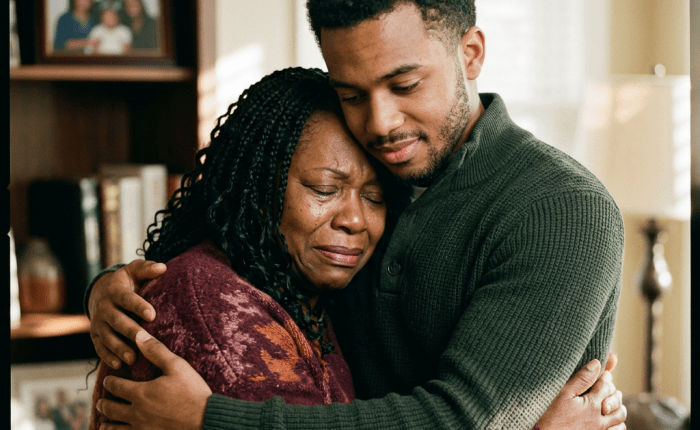
Every May, we gather around tables and pews to celebrate a carefully curated ideal. We polish the pedestals of motherhood, draping them in the fine silk of Proverbs 31 and the fragrant intuition of a perfect love. We speak of a “mother’s love” as a monolith—an effortless, unwavering force that always possesses the right word and always senses the coming storm. We like our motherhood narratives clean, wrapped in Sunday best, devoid of the grit and the gray areas that define the actual lived experience of the women who bore us.
Yet, the reality of the women who shaped us is far more complex than a greeting card can capture. For some, the mention of “Mother” doesn’t just evoke memories of warmth; it stirs a quiet, but lingering resentment. It is the old sting of a decision that set a course for family strife, or the heavy silence of a “protection” that felt more like a prison.
As we reflect on the hands that held our future, we eventually confront a difficult truth: mothers are not deities. They are human beings operating in a broken world. They are strategists in the trenches, making high-stakes decisions with limited tools, often under pressures we cannot fully see until we find ourselves in that same line of fire. To truly honor them—and to find healing for ourselves—we must empathize with their burden of best intentions.
The Strategist in the Trenches
To understand the weight of this burden, we have to look back at the biblical archetype of the “Strategist,” Rebekah. In Genesis 27, we encounter a woman often dismissed as merely “sneaky” or “manipulative.” We see her as the architect of a lie. If we pull back the veil and look at her world, we see a woman navigating a landscape that offered her no legal standing and very few options.
Rebekah lived in a patriarchal culture where the “Blessing” of the husband determined the spiritual and financial transfer of the entire family estate. When she realized that her husband, Isaac—now old and blinded by cataracts—was about to bestow this legacy upon Esau, a man who had already proven he didn’t value his birthright, Rebekah panicked. She knew she couldn’t reason with Isaac’s favoritism. So, she acted.
She prepared a meal, draped goat skins over her younger son Jacob’s hands to mimic his hairier brother, and sent him into his father’s presence with a stolen identity. Rebekah moved the pieces on the board because she felt she was the only one who could see the coming disaster. She risked her husband’s trust and the peace of her home to secure a promise she believed was under threat.
We see Rebekah’s anxiety in today’s mothers. We see it in the mother who works two jobs, missing the bedtime stories to secure a college fund the child doesn’t yet know they need. We see it in the mother who makes the agonizing decision to keep a father away, not out of spite, but because she sees a cycle of toxicity the child is too young to perceive.
These are not decisions made in a vacuum of “effortless grace.” These are decisions made in the trenches, where the oxygen is thin, and the stakes are survival. This is the burden of best intentions: the desperate need to protect and prepare a child for a broken world with only the broken pieces in your hands.
The High Cost of the Wrong Method
The reality is that a “good” intention does not always yield a “perfect” outcome. Rebekah was right about her son’s destiny, but her methodology was flawed. In her pursuit of security, she used deception—a tool that has sharp edges. Though the blessing was secured, the home was fractured beyond repair. By cutting Esau, she cut herself and her family.
As a result of her meddling, she turned her household into a battlefield. Esau harbored a murderous grudge; Jacob had to flee into the night as a fugitive. History suggests that Rebekah likely never saw her favorite son again. She had traded his presence for his protection. She saved his destiny, but she lost his company.
This is the jagged edge of motherhood we rarely discuss. We live in the aftermath of our mothers’ “wrong methods”—the career focus that felt like neglect, the partner choices that brought chaos, or the silence that felt like a lack of support. We must be honest enough to acknowledge the collateral damage. We don’t have to lie about the pain to honor the person. Forgiveness does not require us to pretend the seams of our upbringing are straight; it requires us to understand why the needle slipped in the first place.
In Genesis 27:13, Rebekah utters words that should humble us: “My son, let the curse fall on me. Just do what I say.”This is the heavy lifting of motherhood. Mothers often take on the emotional and spiritual “curse” of their bad decisions so their children don’t have to. They carry the secret guilt of their mistakes like a heavy cloak, willing to be the “villain” in our stories if it means we get to be the “victors” in theirs.
Seeing the Woman, Not Just the Role
Pathways to healing open when we stop judging our mothers for failing to be divine. We expect them to have perfect foresight and never let their own unhealed trauma leak into our development. Forgiveness begins when we realize our mother was just a woman—a woman navigating a storm she didn’t ask for with the limited tools she inherited from her own flawed parents.
When we look at her choices, we have to stop and ask: What was she afraid of? What hole was she trying to fill? What survival instinct was driving that painful decision? As Proverbs 16:2 suggests, motives are weighed by the Lord. If we look at the why behind the what, we often find a mother who was terrified for our safety or desperate for our success. She wasn’t trying to fail us; she was trying to save us, even if she didn’t quite know how to handle the rescue.
The Quilt of Good Intentions
Imagine a mother who sets out to sew a beautiful quilt for her child. She stays up late, her eyes tired and fingers cramped. She wants the best fabric, but she only has scraps—scraps of her own upbringing and heartbreak. She wants straight lines, but the room is dim, and her hands are weary.
When the child grows, they look at the quilt and see crooked seams. They see mismatched colors and tiny, rusted spots where the needle pricked her finger and left a mark of blood. For years, the child resents the quilt, comparing it to the “perfect,” factory-made ones in store windows. They focus on the holes and the missed stitches.
Then life’s cold night comes—a night of loss or failure—and the child realizes that despite the crooked seams, they are warm. They realize the mother didn’t set out to make a “crooked” quilt; she used every scrap of strength she had to make sure they didn’t freeze. Forgiveness is looking at those crooked seams and saying, “I see the effort. I see the love. I forgive the flaws.”
The Final Covering
Ultimately, we find the strength to forgive our mothers because we ourselves have been covered by a “perfect garment.”
Jesus Christ understands the complexity of the human heart better than anyone. He was born of a woman. He watched Mary navigate the “tough decisions” of his own earthly upbringing. He didn’t come to judge us for our flawed strategies or mismatched quilts. He came to take the “curse” that Rebekah spoke of—the curse of our mistakes and our parents’ mistakes—and nail it to a tree.
On the Cross, Christ offered the ultimate “best for us.” He provides the righteousness that covers all our crooked seams. His robe of righteousness is the only one without a crooked seam, yet He trades it for our leaden cloaks of guilt. Because He has forgiven us, we can reach back into our past, take our mother’s hand, and say, “It’s okay. You were only human, and you are loved.”
We release the debt of their mistakes so we don’t have to spend our lives paying the interest on their pain. We take the quilt, crooked seams and all, and we wrap ourselves in the warmth of a love that was always trying, even when it was failing. That is the grace of the crooked seam. That is where the healing begins.


