Crossing to the Other Side: Where Stormy Seas Take Us

Crossing to the Other Side: Where Stormy Seas Take Us

Have you ever obeyed God completely, only to sail straight into a storm?

We often operate under a quiet, unspoken assumption about the spiritual life: if we are walking in alignment with God’s will, the waters beneath us ought to be glass. We tend to link smooth sailing with divine favor, while treating headwinds, turbulence, and unforeseen tempests as evidence that we have somehow missed God’s turnoff. Yet, one of the most striking details in Matthew’s account of Jesus walking on the water directly confronts this myth.

Immediately following the miraculous feeding of the five thousand, Matthew notes that Jesus “compelled”, or literally constrained, His disciples to get into a boat and go ahead of Him to the other side. The disciples did not blunder into a nighttime tempest because of rebellion, spiritual lethargy, or straying from the path. They sailed directly into a fierce, wind-battered sea precisely because they were executing a direct command from Christ.

When your obedience leads you straight into the fourth watch of the night, where the waves are crashing, and progress feels impossible, it is vital to anchor yourself in this truth: the storm is not proof of God’s absence. More often than not, the storm is the very setting where God intends to reveal Himself in ways you could never experience from the quiet safety of a calm shore.

Why did Jesus walk on the water? In our modern, hyper-practical mindset, we might assume it was merely an issue of transportation, a shortcut across the lake to catch up with His friends after a long night of solitude and prayer. However, an exegetical look at the Hebrew Scriptures reveals something far grander. In ancient Near Eastern culture and Hebrew theology, the sea was the ultimate symbol of untamed chaos, danger, and dark, uncontrollable forces. Throughout the Old Testament, treading upon the open, roaring waters was an exclusive domain reserved for Yahweh alone. Job declares that God alone “treads on the waves of the sea” (Job 9:8), while the Psalmist writes that God’s “path led through the sea, [His] way through the mighty waters” (Psalm 77:19).

When Jesus stepped onto the surface of the Sea of Galilee in the dark of night, He was not performing a parlor trick or saving time. He was executing a divine self-revelation; a theophany. As He drew near the vessel, He called out into the dark: “Take courage! It is I. Don’t be afraid” (Matthew 14:27). The Greek phrase translated as “It is I” is Egō Eimi, the exact divine self-designation given to Moses at the burning bush—”I AM.” By standing atop the very waves that threatened to swallow the disciples, Jesus was announcing His identity: I am the Lord of creation, and the chaos that threatens to destroy you is merely pavement beneath My feet.

Before the disciples recognized the Savior, their initial reaction was sheer, unadulterated terror. They cried out, “It’s a ghost!” (v. 26). In the first-century Jewish world, popular folklore held that nocturnal waters were haunted by spirits and malicious apparitions. It is remarkably easy to critique the disciples for their panic, but how often do we do the exact same thing? When darkness settles over our lives, and unexpected trials surge around us, our default human instinct is often to misinterpret God’s active presence as a threat or an omen of impending doom.

Fear distorts spiritual vision. It transforms an approaching Savior into a terrifying specter. Notice, however, how Jesus responds to their panic. He does not instantly alter the physical weather; instead, He speaks His Word directly into their fear. The illusion of the ghost dissolves not when the wind ceases, but when the voice of the I AM pierces the night. Faith begins when we allow the reality of Christ’s character and the truth of His Word to redefine the circumstances that frighten us.

It is at this point that Peter makes his renowned request: “Lord, if it is you, tell me to come to you on the water” (v. 28). Critics often view Peter’s request as testing God or acting impetuously. However, when viewed through the lens of ancient Jewish discipleship, Peter’s motivation becomes deeply moving. A disciple (talmid) desired above all else to follow so closely behind their master that they would do what the master did and mirror the master in every way.

Peter recognized something profound in that moment: if Jesus was standing on top of the storm, then the safest place in the universe was not inside the wooden boat—it was out on the open water beside Jesus. Driven by intense devotion and radical trust, Peter stepped over the gunwale and did the humanly impossible. He walked on water toward Christ.

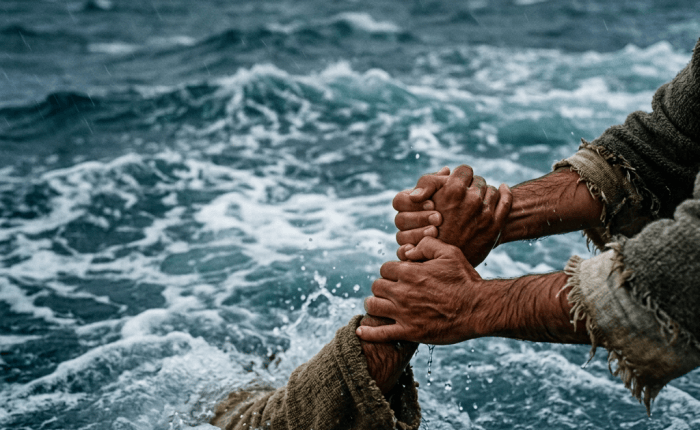
Of course, the story does not end with a triumphant stroll across the lake. Verse 30 tells us that when Peter saw the strength of the wind, he was afraid, and beginning to sink, he cried out, “Lord, save me!” For centuries, sermons have focused almost exclusively on Peter’s failure—how he shifted his gaze from Jesus to the wind and succumbed to doubt. Jesus Himself gently confronts Peter, asking, “You of little faith, why did you doubt?” (v. 31). Yet, there is a vital, transformative lesson here about the nature of genuine faith. When Peter began to sink, what did he do? He did not attempt to rely on his swimming skills, nor did he yell for his fellow fishermen to toss him a rope. His immediate, instinctive reaction was to direct his utter helplessness toward Jesus.

Peter’s short, three-word prayer—”Lord, save me!”—is not the collapse of faith; it is faith in action. True biblical faith is not the absolute absence of fear, nor is it a guarantee that we will never falter. True faith is knowing exactly where to direct your voice when the water reaches your neck. Jesus did not demand that Peter pull himself up by his bootstraps or prove his spiritual stamina before rescuing him. “Immediately,” Matthew writes, “Jesus reached out his hand and caught him.”

Why didn’t Jesus invite the rest of the disciples out onto the water? Why didn’t He let Peter walk all the way to the shore? Because the miracle was never intended to be a human spectacle or an exhibition of individual greatness. The journey on the water was designed to bring Christ back into relationship with the community.

When Jesus and Peter climbed back into the boat, the wind instantly died down. The vessel—which in early Christian theology came to represent the Church (navis)—became a sanctuary. The disciples who had spent the night battling the elements ended the morning kneeling on the deck in corporate adoration, confessing, “Truly you are the Son of God” (v. 33).

If you find yourself in the middle of a difficult crossing today, struggling against relentless headwinds despite doing your absolute best to obey God’s calling—take heart. The storm you are navigating is not an obstacle to His plans. It is the very stage He reveals His identity as the I AM.

When fear whispers that you are seeing ghosts, listen for His voice. When your faith wavers and the waves begin to overtake you, stop trying to swim on your own energy. Cry out the simplest, most powerful prayer ever uttered: Lord, save me. He is immediately reaching out His hand to pull you up, calm the chaos, and carry you safely to the other side.

Take Off the Grave Clothes

Take Off the Grave Clothes

Have you ever stopped to consider how strange it is when God addresses dead things? Throughout Scripture, we encounter moments where the Almighty speaks directly into contexts defined by silence, decay, and finality. In Ezekiel 37:1–4, the prophet is led into a valley filled with sun-bleached human bones, the remnants of lives long gone. In that desolate landscape, God commands Ezekiel in verse four to prophesy to the dry bones and say, “O ye dry bones, hear the word of the LORD.” Centuries later, in John 11:38–44, Jesus stands before a tomb housing His friend Lazarus, who had been dead for four days. In verse forty-three, Jesus shouts into the darkness, “Lazarus, come forth!”

In both accounts, the dead are presumed to be able to hear. They are spoken to not as passive matter, but as entities capable of receiving a command. To human logic, commanding a corpse to listen seems foolish. Yet with God, His words don’t just describe reality—they create it. Theologians call this the effectual call. When God speaks into spiritual or physical death, His Word doesn’t depend on our human ability. Instead, the utterance itself imparts life, forming the ability to respond.

Understanding this truth shifts the primary question of our human experience. The pressing issue facing our souls is never whether God is actively speaking into our dead, exhausted, or stagnant circumstances. His voice is continually echoing across the valleys of human despair and shouting into the closed tombs of our spiritual paralysis. Rather, the crucial question is simple: when His living Word grants you the capacity to wake up, will you step into resurrection life or stay in the quiet familiarity of the tomb?

To respond to this divine summons, we must first recognize that God addresses our potential rather than our present posture. When Ezekiel surveyed the valley in Ezekiel 37, his eyes reported only dry, scattered bones. When Martha stood outside her brother’s tomb in John 11, her perspective was locked onto the reality of decomposition. Human perception is habitually restricted to current states. We look at broken relationships, deeply ingrained habits, spiritual apathy, or suffocating regrets, and conclude that the story has ended. However, God never addresses you based on the static posture of your current failure. His voice decrees what shall be according to His sovereign purpose. When God commanded the prophet to preach to dry bones, He was speaking to an army that had not yet stood up. When Jesus called Lazarus by name, He was addressing a living servant, not a rotting corpse.

This truth demands that we silence the lying narratives that keep us entombed in despair. You are not defined by the graveyard of your past mistakes, nor are you permanently trapped by spiritual apathy. God is not conversing with the corpse of who you used to be, nor is He intimidated by the stench of your past failures. He is actively speaking to the redeemed and resurrected self that He declared before the foundation of the world. The moment you recognize that His voice is calling you beyond your present posture, you are empowered to lift your eyes above your circumstances and respond to your Creator, who is calling you back to life.

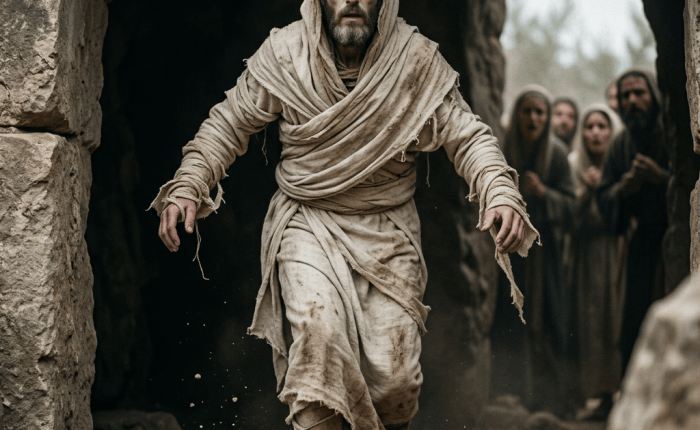
While divine grace provides the capacity to wake up, faith requires a personal choice to step forward into freedom. Consider the mechanics of Lazarus’s awakening in John 11:44. The text tells us that he who was dead came forth, bound hand and foot with grave clothes. Picture that extraordinary moment: a man wrapped tightly from head to toe in burial strips, moving toward the light. Jesus supplied the reanimating power that restarted Lazarus’s heart, yet Lazarus still had to physically shuffle toward the cave’s opening. Resurrection power is an invitation, never a coercion. God’s grace grants you the ability to hear and stand, but He will not drag you out of the tomb against your will.

Far too often, we pray for God to transform our lives while refusing to abandon the shadowed comfort of our spiritual graves. It can feel intimidating to step into the light of accountability and holiness when you have grown accustomed to the dark. The tomb may be unpleasant, but its confines are predictable. Yet, staying in the dark after life has been offered is a choice to embrace deathly unfulfillment. The call has gone out, and the Holy Spirit has imparted spiritual capacity. You must now decide whether you will linger in the familiar shadows of compromise or make the courageous decision to move toward the light of God’s presence.

Furthermore, stepping into life requires us to unbind ourselves from the past and strip away the garments of our former state. When Lazarus emerged from the cave, he was unequivocally alive, yet he remained wrapped in burial garments. Seeing this in John 11:44, Jesus commanded the community, “Loose him, and let him go”—a directive to take off the grave clothes. This striking image illustrates a profound spiritual reality: it is entirely possible to be saved, regenerated, and loved by God, yet still walk around wrapped in the lingering habits, toxic mindsets, and crushing shame of your former existence.

Grave clothes represent old identities that no longer belong to a resurrected child of God. They manifest as the heavy rags of guilt over forgiven sins, the restrictive wrappings of old coping mechanisms, or the dark shroud of negative thought patterns whispering that you will never be whole. You cannot walk fruitfully in the newness of eternal life while continuing to wear the uniform of the grave. Jesus did not call you out of death merely to leave you shrouded in reminders of your captivity. He desires your complete liberation, inviting you to unbind every lingering artifact of death and take off the grave clothes so that you may walk in glorious, unencumbered freedom.

Ultimately, the miraculous restorations in Ezekiel 37 and John 11 were prophetic signposts pointing toward a far greater reality. Ezekiel spoke to a valley of dry bones, and they stood up as an army. Jesus called to a dead friend, and Lazarus walked out of a tomb. Yet years later, those soldiers returned to dust, and Lazarus faced physical mortality once again. But three days after Calvary, when Jesus Christ stepped out of His garden tomb, He shattered the power of death forever. No human voice had to shout into His cave to wake Him, for He is Himself the Resurrection and the Life. By His authority, He broke the bonds of the grave and opened the doorway to eternal life.

In John eleven, Jesus makes the definitive declaration that He is the resurrection and the life, assuring us that whoever believes in Him will live even if they die. Right now, that exact same voice, the voice that rattled dry bones in the ancient valley and shattered the dark quiet of the Bethany tomb, is speaking directly to the depths of your spirit. If you are weary of surviving in the dark cave of spiritual emptiness, and if you are exhausted from carrying the heavy grave clothes of past mistakes, know that your Redeemer is calling your name. Hear the Word of the Lord today, choose life over the tomb, strip away the burial garments of your past, and step boldly into the freedom of His resurrection power. Take off the grave clothes.

Ascending and Descending

Ascending and Descending

Have you ever found yourself stranded in the ‘in-between’? It is that uncomfortable, disorienting space where you have left behind what was familiar, yet you haven’t arrived at where you are going. You are suspended in transit—navigating the wilderness, surrounded by uncertainty, and wondering whether God has somehow lost track of your location.

In Genesis 28, we meet a man caught in the ultimate in-between: Jacob. Verse 10 records a geographical detail that doubles as a spiritual diagnosis: “Jacob left Beersheba and set out for Harran.” Beersheba was home, the land of promise, covenantal security, and family warmth. Harran was a distant, unknown, intimidating territory. But Jacob didn’t leave home on a planned vacation or a peaceful pilgrimage; he fled.

Just chapters earlier, Jacob lived up to the literal meaning of his name—the “heel-catcher” or “supplanter.” He deceived his blind father, Isaac, and manipulated his twin brother, Esau, out of his birthright and blessing. Now, with Esau hunting his life, Jacob runs into the desert with no security detail, no travel companions, no luggage, and no cushion of comfort. He carries only a wooden staff in his hand, a heavy burden of guilt in his chest, and the echo of a death threat ringing in his ears.

When the sun sets, Jacob stops out of sheer exhaustion. The scripture simply notes: “He came to a certain place.”Notice that the text does not even dignify the location with a name initially—it is just “a certain place,” a nameless, barren, dusty patch of dirt in the wilderness. Exhausted, isolated, and terrified, Jacob does the unthinkable: he picks up a rock, places it under his head as a pillow, and falls asleep under the cold night sky.

Can you feel the vulnerability of that moment and the hard edge of that stone? Jacob was at his absolute lowest point, physically exhausted, emotionally drained, socially isolated, and spiritually bankrupt. If anyone seemed entirely disqualified from receiving a divine revelation from the Creator of the universe, it was Jacob on that dark night. Yet, it is precisely in this undeserving place that heaven breaches earth.

As Jacob sleeps on that hard rock, he dreams. In this dream, he beholds a sullam. Traditionally translated into English as a “ladder,” the Hebrew term more accurately describes a massive, elevated stairway or grand stone ramp, much like the ziggurats of ancient Mesopotamia. This was no rickety wooden ladder; it was a majestic highway of stone whose base rested firmly in the earthly dirt while its top reached into the highest heavens.

On this divine highway, Jacob observes a startling detail: “the angels of God were ascending and descending on it.”(Genesis 28:12) Take a close look at the sequence. The scripture does not say they descended and ascended; it explicitly says they were ascending first, and then descending. If angels reside in heaven, why are they going up before coming down?

The early church father Saint Augustine, along with generations of scholars since, pointed out a profound spiritual truth hidden in this order: The angels were already on the ground with Jacob before he even realized it. While Jacob was running in fear, while he was weeping in isolation, and while he was placing his head on a cold stone, God’s celestial messengers were already standing guard in the dirt beside him. They ascended to report, and they descended to minister.

This sequence reveals a crucial truth about God’s character: Heaven is not locked away behind distant, closed doors. We often drift into the quiet misconception that God is an aloof, distant observer who only intervenes when we have our lives completely cleaned up. But the vision of the stairway reveals a bustling, dynamic, continuous connection between heaven and earth. God’s grace is never static; it is constantly active, surrounding us long before our spiritual eyes are opened to see it.

As Jacob’s eyes trace the stairway upward, he sees the Lord Himself standing at the summit. In a human story, this would be the moment for a divine reprimand. We would expect God to say, “Jacob, look at the mess you’ve made! Look at how you lied to your father and cheated your brother! Go back, fix your life, and then we can talk.” Instead, God does not descend in judgment; He descends in covenant.

Listen to the promise God speaks over this exhausted fugitive:

“I am the Lord, the God of your father Abraham and the God of Isaac. I will give you and your descendants the land on which you are lying… I am with you and will watch over you wherever you go, and I will bring you back to this land. I will not leave you until I have done what I have promised you.” (Genesis 28:13-15)

This is stunning grace. Jacob did not pray for this encounter; he did not fast, build an altar, or present an offering. Theologians refer to this as prevenient grace—the grace of God that goes before us. It is the persistent love that pursues us before we know we are lost and meets us when we have nothing left to give. In this revelation, God makes three unconditional pledges: His Presence (“I am with you”), His Protection (“I will watch over you wherever you go”), and His Permanence (“I will not leave you”).

God does not condition these promises on Jacob’s perfection; He anchors them entirely in His own unfailing character. Your present location—no matter how desolate—does not limit God’s capacity to distribute His grace. He does not demand that you escape the wilderness before He meets you; He enters the wilderness to be with you.

In verse 16, the dream vanishes, and the morning sun rises over the horizon. Jacob opens his eyes. Externally, nothing about his physical circumstances has altered: he is still in the barren desert, the wind is still cold, and the ground is still hard. But internally, everything has shifted. Jacob speaks with holy awe: “Surely the Lord is in this place, and I was not aware of it.”

What a profound confession! He does not say God was absent; he admits that he was simply unaware. How often do we walk through our days blinded to the divine presence around us? Caught up in our anxieties, financial pressures, family struggles, or career demands, we trek right past the thin places where heaven meets earth.

Jacob does not leave this encounter as a passive observer. He acts upon it. He takes the very stone he used as a pillow—the symbol of his pain, exhaustion, and loneliness—and sets it up as a pillar. He pours oil over it, consecrates it, and renames the place Bethel, meaning “House of God.” His act of worship transforms the landscape, turning the scene of his deepest vulnerability into an altar of lasting faith.

Centuries later, Jesus stood before His early followers and declared: “Very truly I tell you, you will see heaven open, and the angels of God ascending and descending on the Son of Man.” (John 1:51) Jesus intentionally referenced Jacob’s dream, but with a revolutionary revelation: Jesus did not come merely to point out where the stairway was located—He declared that He IS the stairway.

Jesus is the ultimate sullam. In His divinity, He reaches the highest heaven; in His humanity, He plants His feet firmly in our earthly dust. Through Christ, every place can become a Bethel, and access to the Father is no longer restricted by geography or human merit.

What is the hard “stone” you are resting on today? Is it fear, grief, guilt, or an uncertain future? Do not despise your stone. In the hands of God, the place of your greatest trial can become the monument of His greatest mercy. Wake up to His presence today, for He promises: “I am with you, and I will not leave you.”