
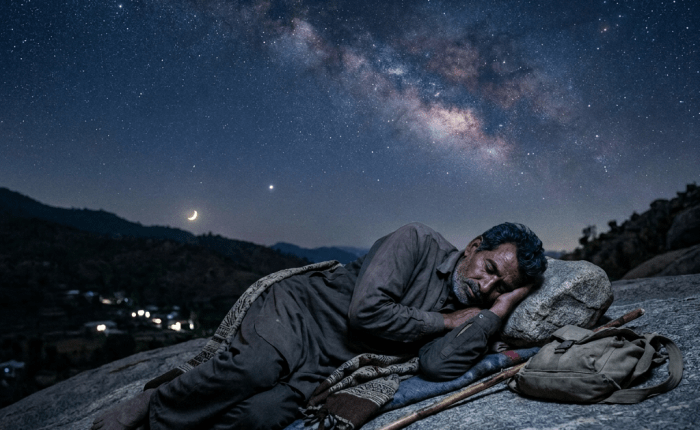
Have you ever found yourself stranded in the ‘in-between’? It is that uncomfortable, disorienting space where you have left behind what was familiar, yet you haven’t arrived at where you are going. You are suspended in transit—navigating the wilderness, surrounded by uncertainty, and wondering whether God has somehow lost track of your location.
In Genesis 28, we meet a man caught in the ultimate in-between: Jacob. Verse 10 records a geographical detail that doubles as a spiritual diagnosis: “Jacob left Beersheba and set out for Harran.” Beersheba was home, the land of promise, covenantal security, and family warmth. Harran was a distant, unknown, intimidating territory. But Jacob didn’t leave home on a planned vacation or a peaceful pilgrimage; he fled.
Just chapters earlier, Jacob lived up to the literal meaning of his name—the “heel-catcher” or “supplanter.” He deceived his blind father, Isaac, and manipulated his twin brother, Esau, out of his birthright and blessing. Now, with Esau hunting his life, Jacob runs into the desert with no security detail, no travel companions, no luggage, and no cushion of comfort. He carries only a wooden staff in his hand, a heavy burden of guilt in his chest, and the echo of a death threat ringing in his ears.
When the sun sets, Jacob stops out of sheer exhaustion. The scripture simply notes: “He came to a certain place.”Notice that the text does not even dignify the location with a name initially—it is just “a certain place,” a nameless, barren, dusty patch of dirt in the wilderness. Exhausted, isolated, and terrified, Jacob does the unthinkable: he picks up a rock, places it under his head as a pillow, and falls asleep under the cold night sky.
Can you feel the vulnerability of that moment and the hard edge of that stone? Jacob was at his absolute lowest point, physically exhausted, emotionally drained, socially isolated, and spiritually bankrupt. If anyone seemed entirely disqualified from receiving a divine revelation from the Creator of the universe, it was Jacob on that dark night. Yet, it is precisely in this undeserving place that heaven breaches earth.
As Jacob sleeps on that hard rock, he dreams. In this dream, he beholds a sullam. Traditionally translated into English as a “ladder,” the Hebrew term more accurately describes a massive, elevated stairway or grand stone ramp, much like the ziggurats of ancient Mesopotamia. This was no rickety wooden ladder; it was a majestic highway of stone whose base rested firmly in the earthly dirt while its top reached into the highest heavens.
On this divine highway, Jacob observes a startling detail: “the angels of God were ascending and descending on it.”(Genesis 28:12) Take a close look at the sequence. The scripture does not say they descended and ascended; it explicitly says they were ascending first, and then descending. If angels reside in heaven, why are they going up before coming down?
The early church father Saint Augustine, along with generations of scholars since, pointed out a profound spiritual truth hidden in this order: The angels were already on the ground with Jacob before he even realized it. While Jacob was running in fear, while he was weeping in isolation, and while he was placing his head on a cold stone, God’s celestial messengers were already standing guard in the dirt beside him. They ascended to report, and they descended to minister.
This sequence reveals a crucial truth about God’s character: Heaven is not locked away behind distant, closed doors. We often drift into the quiet misconception that God is an aloof, distant observer who only intervenes when we have our lives completely cleaned up. But the vision of the stairway reveals a bustling, dynamic, continuous connection between heaven and earth. God’s grace is never static; it is constantly active, surrounding us long before our spiritual eyes are opened to see it.
As Jacob’s eyes trace the stairway upward, he sees the Lord Himself standing at the summit. In a human story, this would be the moment for a divine reprimand. We would expect God to say, “Jacob, look at the mess you’ve made! Look at how you lied to your father and cheated your brother! Go back, fix your life, and then we can talk.” Instead, God does not descend in judgment; He descends in covenant.
Listen to the promise God speaks over this exhausted fugitive:
“I am the Lord, the God of your father Abraham and the God of Isaac. I will give you and your descendants the land on which you are lying… I am with you and will watch over you wherever you go, and I will bring you back to this land. I will not leave you until I have done what I have promised you.” (Genesis 28:13-15)
This is stunning grace. Jacob did not pray for this encounter; he did not fast, build an altar, or present an offering. Theologians refer to this as prevenient grace—the grace of God that goes before us. It is the persistent love that pursues us before we know we are lost and meets us when we have nothing left to give. In this revelation, God makes three unconditional pledges: His Presence (“I am with you”), His Protection (“I will watch over you wherever you go”), and His Permanence (“I will not leave you”).
God does not condition these promises on Jacob’s perfection; He anchors them entirely in His own unfailing character. Your present location—no matter how desolate—does not limit God’s capacity to distribute His grace. He does not demand that you escape the wilderness before He meets you; He enters the wilderness to be with you.
In verse 16, the dream vanishes, and the morning sun rises over the horizon. Jacob opens his eyes. Externally, nothing about his physical circumstances has altered: he is still in the barren desert, the wind is still cold, and the ground is still hard. But internally, everything has shifted. Jacob speaks with holy awe: “Surely the Lord is in this place, and I was not aware of it.”
What a profound confession! He does not say God was absent; he admits that he was simply unaware. How often do we walk through our days blinded to the divine presence around us? Caught up in our anxieties, financial pressures, family struggles, or career demands, we trek right past the thin places where heaven meets earth.
Jacob does not leave this encounter as a passive observer. He acts upon it. He takes the very stone he used as a pillow—the symbol of his pain, exhaustion, and loneliness—and sets it up as a pillar. He pours oil over it, consecrates it, and renames the place Bethel, meaning “House of God.” His act of worship transforms the landscape, turning the scene of his deepest vulnerability into an altar of lasting faith.
Centuries later, Jesus stood before His early followers and declared: “Very truly I tell you, you will see heaven open, and the angels of God ascending and descending on the Son of Man.” (John 1:51) Jesus intentionally referenced Jacob’s dream, but with a revolutionary revelation: Jesus did not come merely to point out where the stairway was located—He declared that He IS the stairway.
Jesus is the ultimate sullam. In His divinity, He reaches the highest heaven; in His humanity, He plants His feet firmly in our earthly dust. Through Christ, every place can become a Bethel, and access to the Father is no longer restricted by geography or human merit.
What is the hard “stone” you are resting on today? Is it fear, grief, guilt, or an uncertain future? Do not despise your stone. In the hands of God, the place of your greatest trial can become the monument of His greatest mercy. Wake up to His presence today, for He promises: “I am with you, and I will not leave you.”

 Meditations By Lee